
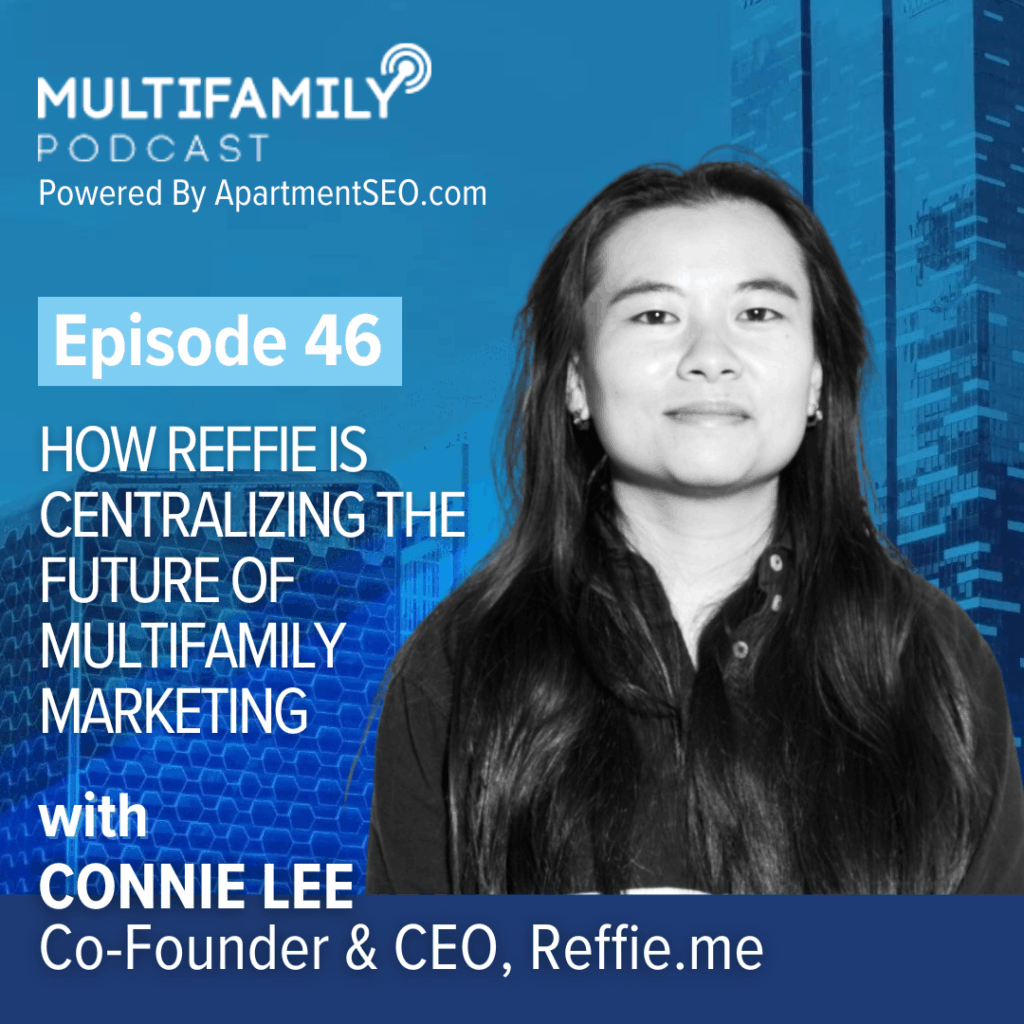
Swipe Right on Leasing: How Reffie is Centralizing the Future of Multifamily Marketing Featuring Connie Lee, Co-Founder & CEO, Reffie.me
Ronn Ruiz and Martin Canchola, Co-Founders of Apartment SEO
Featured Guest: Connie Lee, Co-Founder & CEO, Reffie.me
Martin: Hello. Welcome back to The Multifamily Podcast with Ronn and Martin, powered by ApartmentSEO.com. We’re here to explore people, technology, and ideas transforming the apartment industry. And today’s guest is someone I personally met at Blueprint Real Estate Technology Conference in Las Vegas just recently. Such a fun time there, getting to know a bunch of new founders, new startups, and a lot of great things taking place. And I had a good opportunity to actually watch Connie do a live presentation. And really, she had the whole crowd swiping right. She’s the co-founder and CEO of Reffie.me, helping real estate operators fill vacancies faster with centralized leasing software that blends technology with human connection. We’re going to talk about how leasing is like dating, what centralized leasing means, and how the future of Apartment Marketing is being redefined. Connie Lee, welcome to the multifamily podcast.
Ronn: Right on. Well, Connie, let’s just jump right into it. I’m really excited that you and Martin obviously connected. I personally always love hearing how great ideas started, particularly for Multifamily. So, if you don’t mind starting to tell us about your journey. How did you get into Multifamily, and ultimately, what inspired you to launch Reffie?
Connie: Yeah, I mean, there’s like, a couple kinds of startup founders. One is like, they have a really well-planned thesis, and they go and tackle it. I wish I was kind of like one of those folks; instead, it’s much more spontaneous and accidental. So before starting Reffie, I actually used to run sales teams and rev ops teams at a number of different startups. So I was like, essentially running the tech version of leasing or like inbound sales, right? And as a child of immigrant parents, stereotypically, I very quickly got convinced by them that I should become a landlord, because they gave me a lot of lectures about how I should not throw money away on rent. But when you become a landlord, you very quickly realized there’s a lot of things you have to do, and one of the important ones was leasing. And though the personal portfolio my husband and I have is actually also a little bit chaotic as well, which is, we have a number of single-family houses in Los Angeles that we rent by the room. So, it’s like scattered site, Multifamily all in one go. And so, leasing very quickly became an issue logistically, and then also, like, volume-wise, because it was in LA as well. And honestly, it was an accident, because one weekend we had a couple units that we had to fill, and in LA, you should be able to fill them if you can run a process, because you almost have unlimited demand for your rentals. But it was very difficult because I didn’t have anything to run it on, versus, like me going to work and running the sales teams and buying them, Salesforce, Front, Tripify, you know, the smart like all of these tools, right? And I went home and essentially, kind of cherry rigged one of the first no-code versions of Reffie, mainly because I was getting so many leads from so many places, and I needed to text or call all of them back to even figure out where to get started on leasing. And honestly, that’s like, how ready started. I just needed to lease my own units because my names were, my name was on the mortgage.
Martin: Awesome. I mean, so many of the best innovations in the space really come from identifying your own personal pain point for solving that. And then that’s when I think that aha moment, you know, kind of comes upon you, and when you had your aha moment, when you realize leasing teams needed a centralized solution. That’s something that you could bring to the masses for Multifamily. How did that, you know, how did that come to be?
Connie: It started from, so at that point I had like, the no code version of Reffie sort of running on my home desktop and my cell phone, and a lot of my real estate friends who had actual real portfolios in LA like, maybe they had like 50 houses, or they had a handful of apartment buildings. They were watching how my free time essentially opened up, and I was essentially pre-leasing, or, like, mostly leasing my apartments much faster than their own teams were, and roughly offhand as well. So, they started getting interested in using it, and that was like the first aha moment. I was like, okay, maybe someone with a larger portfolio than me also still has this problem, and it’s not because they can’t afford a solution, just because there’s no solution. And then from there, I started doing more research, where like I started calling friends at Griestar, or like Blackstone or whatever, and like a very large portfolio. And I realized the portfolio, the problem actually just never got solved, even if you go all the way up to that enterprise, because at the end of the day, the everyday user that is leasing out your units are just like regular people in Tuscaloosa or, like you know, Birmingham, Alabama, and they need usable software that they’re used to that can get plugged in today, versus some sort of like, giant enterprise platform that requires 10 people to buy in and like another like 12 person IT team to implement.
Ronn: That’s totally huge, and congratulations on the growing portfolio. That’s amazing. It’s always like something you could rest on, right? Real estate is the place to be. So, looking back now, obviously, what were, we know firsthand, Martin, I especially, what were some of the early challenges or lessons that really helped shape how the Reffie platform is to, is what it is today?
Connie: I think one of the hardest things in real estate is adoption, especially adoption across the wide variety of users you meet. So very early, I didn’t realize that anything, anything I came up with my co-founder, that we thought was simple, actually not simple enough, still. And we’d go and meet people, and they’d be like, I don’t know how to use this. I don’t click this. I’m running around all day. I can’t cook it like this, and we have to simplify it more and more. And I like that challenge a lot because, honestly, it made for the growth of the company possible, just because we simplified and made everything so streamlined, just like the interface that you interact with, which really helped, because as we found our footing as a company, we realize that our best place for now is actually selling to mid-market or SMB property management companies. And for those companies specifically, you need something they can pick up very quickly, because their problems are problems today, and they don’t need something that’s like some sort of giant okay, are two years from now with the present at some sort of company all-hands. So that’s probably one of the biggest challenges early on, and still, we face it every day now, even as we release new features, because we’re always like, oh, this would be a great AI feature, and it would demo so well with our investors. But then we’re like, wait a minute. Okay, nobody, no regular person you know, is actually going to be able to pick this up.
Ronn: Yeah, that’s huge.
Martin: So, Connie, your session at blueprint Vegas was a hit. I mean, I was there right in the front row, pretty much comparing, and you were comparing leasing to swiping on a dating app, which I thought was a great analogy. Now, for anyone who didn’t catch it, can you walk us through that analogy and what inspired it?
Connie: Yeah, basically, the analogy is that, what inspired it, honestly, is that I had to explain it over and over again to a bunch of investors, and most, almost none of them have ever done leasing, and they just couldn’t understand, sort of, how fragmented the marketing world was, the PMs world was, and sort of all the ways that you would have to run your funnel. And the best analogy I could come up with, because, like most VCs that you end up talking to are, unless they’re the partners, they’re actually fairly young, and they’re probably actively dating. So, I came up with the analogy, which is like, pretend you have a crazy friend who’s like determined to get married this year. So, they go and download every single dating app all at once to run the dates. You would tell them that’s a terrible idea, because you’re like, how are you going to remember who’s who, and you’re going to like open every app every time you’re trying to answer people? That’s insane, but that’s kind of what a lot of leasing looks like if you don’t have a centralized CRM. Instead of opening Tinder, Hinge, and like Bumble, you’re opening a tab for Zillow, a tab for rent.com, a tab for apartments.com. Then some people move into your email and your cell phone, just like dating, if you move further down the funnel, and now you’re trying to juggle everything at once. And that’s essentially how the analogy came about. I just had to explain leasing and why it was such a problem to investors who had never done leasing so much that I just like to pick something that they can understand.
Ronn: That’s hilarious. I love that. So, it’s funny how they could relate to the dating versus, just like finding a home, right?
Connie: Yeah. Well, most of them, when they heard the leasing problem, they almost thought it was like a no-brainer, like why wouldn’t you have it? But I was like, they actually don’t. And honestly, you don’t have one in dating either. It’s not like you have a dating aggregator
Ronn: And right then and there is when you’re like, okay, see, you get it now. Why isn’t it already done, right? So, it is totally so true. Renders, obviously, we have tons of browsing options, more and more, good and bad, messaging committees, and making decisions, obviously, the same way they basically make dating decisions. I love the analogy, by the way, so I can’t get over that. But what, what can leasing teams learn, really, from the behavior to better connect with prospects? I think that’s the real piece here.
Connie: Yeah. I mean, there’s a lot of tactics, actually, that if you date it this way, honestly, probably also make you a better leasing agent. Like if you think of it in terms of the world of digital dating, now it’s very high transaction volume, so you have tons of matches coming through, but it’s still an emotional purchase, and you want us to find some way to automate it. But the more you automate, it actually hurts your conversions on dates, because obviously, if you sent everyone some sort of generic message with no name on there, and it’s like blasted everyone, everyone’s probably will be able to see through and ignore you on the dating apps, which is the same thing for leasing, which is, it’s very high transaction. Tons of leads will come in per unit, and you’re usually managing multiple vacancies at once. So basically, you have a huge lead volume. You as a leasing agent, you’re incentivized to try to work through the leads as fast as possible, but still get conversion, and you’re probably going to lean towards the more easy methods. Unfortunately, most of them will dehumanize the message and then also hurt your conversion. Like obviously, you can select all and send them a bulk message. Will they answer it? Probably no. You can also put them on a group, group text chain, or group email and get them all at once as well. Will that convert? Definitely not as well. Which is like all things that you have to think about in terms of both when you’re trying to convince people to go from the dating app to a first date, and honestly, convincing people to go from clicking on Zillow to actually putting in time on the weekend to come to the tour.
Martin: Yeah, that analogy really hits home because at the end of the day, renters aren’t just looking for square footage; they’re looking for that true connection, lifestyle, and trust. So Connie, that comparison really clicks, because finding an apartment is such an emotional decision. I remember when we first started our company back in Long Beach. I mean, I was moving from our home out here in Lakelse are two Long Beach downtown, and you know, you know, there are certain things that we had to find in that community that was, you know, near our office, and just, you know, we felt safe and just had everything we were kind of looking for. So, I mean, that’s a really big decision for somebody looking to find that place and call it home. So how does Reffie help leasing teams create those personal, meaningful connections with renters at scale?
Connie: Yeah, so the way our system works is that, as the leads come into CRM, we allow you to set up automations that you can send, sort of like short messages via text, email, or Facebook message out to these leads. And the goal isn’t to just hopefully only automate the whole conversation; you never have to talk to them. The goal of these automations is to collect data. Like you send a ping to a lead, and you measure how engaged they are with you, and then we start ranking them for you, and then we always measure, sort of like, the performance on your, on the message you sent itself, that way over time, we can start saying things like, hey, your demographic really does not respond to emails. You guys should really just only send text messages to people, and maybe jump the call or say things like, I don’t know you guys, like, are doing senior housing, and almost no one’s going to answer you through text, try email instead, or like throw in smiley faces. That way, we never remove the human fully from the process, but we are using a lot of the data to empower the human, so that they’re always working the leads that are most serious, most likely to convert, and in a messaging tone that will actually help you convert. Because the fun thing is, as much as like management always, you know, disparages the on-site team and says they don’t work leads, almost every leasing agent I’ve met, you know, if I held a gun to their head and I told them to look at the top 10 leads in their CRM. They can tell me by gut which one they think will actually show up for a tour, and which one is like, just like a looky-loo and shopping. And that’s sort of that gut instinct they have from experience. And you can actually immortalize that sort of tribal knowledge and gut instinct into a software. Now if you just like, watch a human work overtime and be like, hey. Like Nancy, like how are you? How do you know these three needs are going to convert? And they’ll tell you exactly why. And you can start implementing those tips into a CRM.
Martin: Actually, before we go into the next, the next segment really quick. You actually mentioned something in your presentation. And you don’t have to get into like any property management names or anything like that. But the idea of that, you know, possibly having like a typo or something in the text to make it seem more real, had an actual better conversion rate in some cases.
Connie: Yeah, it does. We found that out accidentally, because the way our automations work is that we suggest a message is for you, but you’re also completely free to delete the text and then like write whatever you want. And someone had had a typo automation and like, a crazy response rate out of everyone, they’re like, beating everyone, and we’re trying to figure out why. And then eventually found that automation, we’re like, oh, this is it. And we started telling all of our users as like a funny joke, saying, hey, if you want your conversion rates to bump up, you should just throw a typo in there. Most of them obviously will not incorporate it because it’s not very corporate and professional, but you know, like, I’ll throw it out for everyone else who’s listening, is that if you open your first message using text and then, specifically, maybe in the hey swap the y and the E, you’ll probably see like, a 15 or 20% bump in getting a response, which is the most important piece, right? Because, like, the way the funnel works is you want as many people to move to the next step as possible, because you’re going to get them cold. So, on the first one, you should try to get it, like, I don’t know, 80% conversion, if you can.
Martin: Yeah. And it’s almost like that typo almost makes it seem like you’re a real human.
Connie: Right.
Ronn: Yeah. It sounds unconventional to your point about like the branding and the whole, you know, messaging that you’re trying to portray that professionalism, but to that point, it does make you sound human.
Connie: The worst, first message you can actually send is the generic ones. You guys have already seen where it goes like, Hi, my name is Connie. I’m the leasing agent for Willow Brook Estate, and I’ll be working with you. It’s like, it was like it like waste three sentences in introducing themselves. Like that’s the worst conversion one.
Ronn: Yeah, that’s hilarious. Yeah. I would love to see more of what you guys put together, but moving on into a centralized lease. And this is a topic that I love, and we also brand ourselves as a centralized marketing agency to support centralized leasing. Obviously, it’s been a big trend in Multifamily. More importantly, probably post-COVID. Raffie obviously seems to be leaving the church. So, for our listeners who may not be as familiar with centralized leasing, what exactly is it in your interpretation, and why is it so transformative for Multifamily?
Connie: Yeah, okay, so you guys correct me if I’m wrong, but my like, there’s like a couple of definitions that are kind of floating around now. The first one I know that’s specific to leasing, is essentially going from on-site teams of like two to three, doing all leasing applications, everything on site, to basically downscaling the number of people, maybe down to like one or two. And then having a call center type deal at a specific location, and they’re the ones fielding all first inquiries, and then maybe only sending tours to the on-site people and scheduling tours for the on-site people, and then maybe application goes back to that on-site team. That’s usually the way I see centralized leasing, which is funny, because in Multifamily, that’s like a new trend. But if you look at scattered type single family, they’ve always done it that way, because how could they have people sitting at individual houses? And obviously, it’s very transformative, because one, it cuts costs for the company and, like increases ROI, because you pay less salary. But I think the also more sort of cultural goal is that they’re hoping that if they remove that extremely time-intensive leasing part from the on-site team, maybe the on-site team will be better sort of customer experience folks at the building, instead of always being like, Call Center people. Other one, where they’re like, you’re like, moving APMs around as well. That one I know less about, because that one’s much more about, like accounting and maybe, like Regional Director structures.
Ronn: Yeah, no, you’re 100% on target. When I was leasing myself back in my day, that’s how I started the industry. Yeah, I look at the best days, and I could provide the best service to the person calling or the person showing up in front of me. So, with this whole centralized leasing, I’m like, imagine just that 110% experience every single time without having the distraction of, oh, sorry, somebody’s in front of me. I gotta start cutting it short. So definitely you got it right.
Martin: Yeah, that’s such a good breakdown. And from your experience, how are centralized teams using your data and automation to manage leads more effectively while still keeping that human local touch in the leasing process?
Connie: Yeah. So the way, like our software works is that within the first, at the end of the first month, what we usually do is we put together, we spend some time and we put together, like a meeting where we go over, sort of like your benchmark analytics, we try not to say anything should change much in the first month, because that way we can come into the data and say like, this is how your team is roughly converting things. And these are like the bottlenecks, like maybe, for example, you have you guys have a great response rate. Every lead that comes in, 80% of them are talking to you guys. But unfortunately, not that many are converting to tours. So something is happening in conversion, conversation the tour, right? And then from there we, we kind of, you know, nudged a team on all certain aspects of the conversion funnel through with them, so that we could figure out, like iteratively, how to improve all the conversion rates. And usually, we do that with the humans on team, because we’ve like not implemented any sort of chatbot or anything that we’re just like, here’s your data. This is what’s going on. We could probably pick some things to fix your conversation tours or towards the applications, and then every like, couple months from there is like a new problem we find. Like oh, we finally fixed the front part. What about the back part? Leasing, unfortunately, probably is never perfect. Once you fix your full funnel, eventually you figure out things like, oh my God, why is it not give me leads anymore? Am I spending my dollars right or wrong? And that’s kind of how our analytics really helps teams, which is you can see the humans, and then you can also see the computer side, which is the performance marketing side. And then finally figure out like, where on the balance scale do you want to nudge things?
Ronn: Yeah. And to that end, do you think this model will eventually become the standard across the industry, or will there always be a balance, need to be a balance between centralized and on-site leasing roles?
Connie: I think, I think it’s always going to be a constant fight, because it’s kind of like, let’s say everyone finds out centralized is great. It’s great for your profit margins. You cut, you get radar, you steal a bunch of money, and then everyone moves centrally. And then some up-and-coming PMC realizes, if they do on-site, they’re seen as like a premier apartment building, because they actually have people, and they start making a little bit more money. And then everyone else is like, wait a minute. Well, I can afford to increase my optics a little. And then like, everyone swings back the other side. I feel like that’s probably usually what happens.
Martin: Yeah, that’s multi…
Ronn: Yeah. I think business in general, right? Like you get a new concept, especially if it’s money saving, you get all the powers that be at the top saying, yeah, yeah, yeah, go, go, go, and then yeah, how can we do better in service or whatever? And then it comes back to OG old school.
Connie: Right.
Ronn: That’s awesome.
Martin: Now, this next second segment, I’m definitely really interested to learn more from your perspective, because it definitely was an eye-opener for me, and I think there’s a lot of potential. So, shifting to marketing, Connie, you’ve been vocal about how Facebook Marketplace is still a powerful leasing channel, yet so many operators still overlook it. Why do you think that is?
Connie: I think traditionally, Facebook is, has like a bad rap. It’s seen as sort of like a Craigslist-type deal. There’s a lot of scams that happen on Facebook and whatnot, but it’s kind of funny, because Facebook has this thing now, similar to Zillow, where when you make a posting, you know the address in, and if someone’s taken the address, you can’t make another listing there. And I think you have to like claim it. And the only other way, like Zillow does the same thing. Obviously, there are scammers on Zillow as well. And instead of putting the real apartment community address, they put the parking lot, so it kind of like fudges it a little, but, you know, Zillow catches it. You can do the same thing on Facebook. But honestly, the more compelling piece about Facebook is that; you should want to own a listing. But two, what we’ve learned over time is, if you’re in a demographic and city that actually works for Facebook. So, like, if you’re like, in Atlanta, Boise, you know, like a large metro area, not somewhere like in like Brunswick, Georgia, which only has like 15,000 people, you will probably get equal or more volume from Facebook than Zillow. But the catch is that, one, it’s free, and two, you do have to understand Facebook conversions are much lower than Zillow, but the volume is huge versus it, right? Like, it’s like the equivalent of you put an ad on the Super Bowl, and obviously, everyone watches the Super Bowl is not really your demographic. But that doesn’t matter, because even 1% of the Super Bowl watchers converting is crazy. That’s like more volume than you ever need, and that’s kind of how Facebook works. And honestly, it started because, one, I don’t like paying for iOS sites when I don’t need to, like who wants to spend money they don’t need to. And I found out that I could lease my entire unit portfolio based on Facebook Marketplace and Zillow, and I don’t have to spend that much on marketing. A lot of our users also realize that if Facebook works for their portfolio, they could probably save like 8% of marketing every year, right? Because, like you, there is a volume game. You just need as many people through top of the funnel and then enough people to make it to the bottom.
Ronn: 100% Yeah, we totally still see some opportunities there as well. So, what are some creative or data-driven ways you’ve seen operators use the marketplace to drive more qualified leads?
Connie: I think the creative way I’ve seen it is that almost everyone who does use Facebook a lot have realized that they will get a huge volume. But it’s kind of as a little bit like needle in a haystack type situation, where you have to work all over and find them, which is very tedious. So they’ve all sort of either homegrown ways to filter people out or manage that volume. So it’s kind of interesting, because usually in leasing, you know, like, some people have a volume issue, and for them, you’re always like, wow, that’s so nice for you that you have a volume issue of leads. But the Facebook people have figured out ways to do it. We allow you, so like something we allow in Raffie that works very well and for Facebook Marketplace leads, is that; we will allow you to auto respond on the first go to a Facebook message and then push all the ones that don’t respond to you all the way at the bottom, and then set up another automation that will ping the ones that ghosted you to see if they’re alive or not that way, maybe of 100 leads coming from Facebook, we will help you message all 100 and then only show you the 15 that are willing to engage with you. Which, yeah, which like saves you a lot of time, and it’s nice because if any of those 15 leads converts to a lease, your CAC was zero knowledge.
Ronn: Right. Yeah, that’s huge, yeah, and it definitely helps, you know, clean up that funnel.
Connie: Yeah.
Martin: Then you can keep paying the funnel a little bit. And then, I guess abandoned leads as they come in and kind of figure that out. But see thinking beyond Facebook, what other emerging platforms or social channels are you watching that could become the next big leasing frontier?
Connie: I’m actually watching Instagram and TikTok a lot because I’ve realized that; I didn’t realize that until recently, maybe like 12 months ago. But there’s like a small, growing and following for apartment locators, brokers, realtors, who make these sort of very funny Gen Z-type of post, like look at this apartment. It’s like, it like cuts it really fast. And they’re very weird. And I think it grew because both Instagram and TikTok are so good at geolocating on the algorithm. And then obviously the apartment locators were in commission. So you know, if it’s working and they keep doing it, it’s clearly paying their bills. So, we’ve been asked a couple times by member firms that do find traction on TikTok and Instagram, if we’re able to plug in that messaging channel to pull leads in as well. A couple, like a year ago, not many people asked, but now I’m hearing it maybe like every two months, someone is asking about it. So, I’m kind of watching that because, you know, real estate is a little bit more of a slower industry, and I’m curious how many firms are going to be able to convince on-site teams to post on TikTok and Instagram for them.
Martin: Yep, that is, that is definitely a challenge for them. And you do have to be pretty consistent on TikTok for sure.
Connie: Right.
Ronn: I saw a funny video the other day on my IG feed, and it was, and it said, being a realtor in 2025, and basically, like resorting to, like, being silly and unique, this guy doing these crazy dances in each room of the house that he was trying to sell. And I just thought that was creative. I thought that that kind of content could be more for an IG reel or TikTok versus even, like a Facebook, you know.
Connie: Well, it’s funny, because we have a user on DFW, and one of the leasing agents doesn’t do TikTok, Instagram. She does Facebook videos, which is like, who uses that? She does videos, and they go viral, and she has like, like, 500,000 views on one of them. She was like showing me last time I was on site. And so they, luckily for them, because she does that, they have insane volume from Facebook. And you know, I don’t know all the communities in the area, they’ve maintained a like, mid-90s occupancy, mainly because their top of the funnel is so good.
Ronn: Wow, yeah, it’s not a leads problem, right? It’s the eyeballs. So, this is going really fast, and I love the flow, and I have so many more questions. But before we wrap, what is next for Raffie, any exciting features, partnerships, circles that you’re working on?
Connie: Yeah, yeah, we’re really excited for like, sort of the upcoming roadmap. We’re about to close our second round of funding, so that’s going to really put an influx of like momentum into the company. But like a lot of our upcoming features are around sort of ways that we can better empower the humans with AI. And it’s a lot about like that, capturing that tribal now, like I was talking about, we’re releasing a lot of sort of AI assistant features, where like, think of like this little angel that sits on your shoulder going, hey, hey Ronn, Hey Martin. Like these are the top 10 leads, and honestly, they’re most likely to convert. You should just focus on these right now and close them out. Or maybe like, hey, it seems like you guys always stop people between the tour and application stage. Let’s try AB test of messages and see if we can bumper conversions. And that’s sort of what we’re trying to immortalize into the product. Not only suggesting things from you guys, but watching the humans work, and taking learning from that, and then packaging it up, supporting team members.
Ronn: That’d be great.
Martin: Connie, you have such a unique lens on the Multifamily industry. Where do you see Apartment Marketing and leasing headed in the next few years? And what advice would you give operators who want to stay ahead of the curve?
Connie: I see a lot of apartments located, Apartment Marketing and leasing kind of, kind of mirroring, sort of what the tech industry has sort of always done. Like in the tech industry, you have, you know, a huge amount of people always working in, sort of just performance marketing as a department, and do crazy things. They like, they’re like, doing programmatic ad buying, bidding, a CPC, CPL, like very, very granular map and marketing. And I think real estate for it has had the benefit for a lot of years where, like, the supply and demand of apartments has always been skewed, and you could essentially not work that hard and get your apartment leased up, and the rents kept going up. But now, as things are sort of stabilizing in terms of the ratios, people are realizing they have to go find an alpha and get impressions, getting views, sort of basically fixing the funnel. And I think a lot of our marketing is going to be moving towards that way, a big focus on marketing performance, or like ways to get your brand out there. For example, I think people are now more vocal about how the best leads you get are from your own website, which is sort of like, obviously, every tech company or every like big company nowadays, knows that obviously, if someone goes to Cocacola.com they’re your best kind of customer.
Ronn: Yeah, absolutely. Thank you. Say it louder for people in the back. We always preach that about the websites and helping to get them, you know, out there as well. So, I know we have to go, but before we do, honestly, Connie, on a personal note. I always like to just hear personal stories. What keeps you inspired as a founder in this ever-evolving industry?
Connie: I think it’s, I mean, it’s kind of cliche to say, but it is, it is definitely our users. My whole family is very blue-collar. I’m like the only one not doing this blue-collar work. And I love our users, because they’re just like regular people, going to work, trying to do their job, and stay sane. When on-site, leasing is a very chaotic job, right? Like you’re a current resident therapist, you’re a part-time accountant, you’re changing or chasing rent collections, and then they’re getting yelled at because they’re like not increasing revenue and selling enough, right? So I love that our software is just helping normal people try to do their job as best as possible in the best way. And traditionally, leasing has typically gotten very outdated tools or no tools, and they’re just told to like man the phones. And I love that we are essentially innovating in that industry well.
Ronn: And the other thing is that, I mean, the, yeah, while the industry may have stayed, you know, in certain eras, the consumer is changing, and so you’re helping to facilitate, you know, that marriage, right?
Connie: Like so many of the software do email only, or email first, and text is like, you know, like a fourth line. It’s crazy, because how many people do you know are addicted to emails versus their cell phones?
Ronn: No, my old team knows like, text me first and then we can set up a time to talk. Just kidding.
Connie: Yeah. Like if you ask someone on a first date, you wouldn’t email them.
Martin: Connie, thank you so much. This has been such a fun and insightful conversation. I love how you tie human behavior, technology, and leasing strategy all together. It’s clear that Raffie is helping operators really rethink how they approach the entire renter’s journey. So, for everyone listening, go check out Reffie, R, E, F, F, I, E.me, to learn more about how centralized leasing can transform your marketing and operations. If you enjoyed this episode, please be sure to subscribe to the Multifamily podcast at multifamilypodcast.com. We’re on Spotify, Apple, wherever you can listen. And thank you for listening to the Multifamily podcast powered by apartmentseo.com. Until next time, bye y’all, bye Connie, bye. Ronn.
Ronn: Cheers.