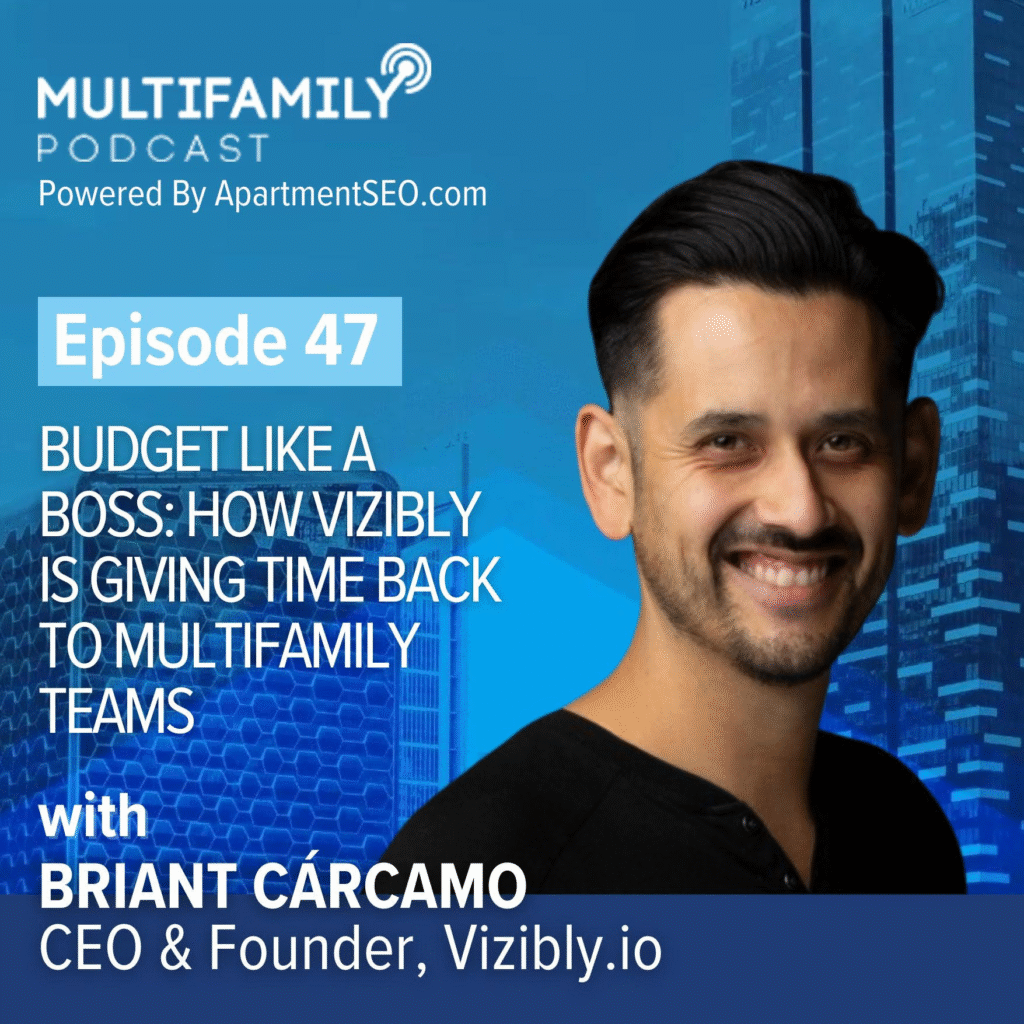
Budget Like a Boss: How Vizibly is Giving Time Back to Multifamily Teams Featuring Briant Cárcamo, CEO & Founder, Vizibly.io
Podcast Hosts: Ronn Ruiz and Martin Canchola, Co-Founder of ApartmentSEO.com
Budget Like a Boss: How Vizibly is Giving Time Back to Multifamily Teams Featuring Briant Cárcamo, CEO & Founder, Vizibly.io
Martin: Welcome to The Multifamily Podcast with Ronn and Martin, powered by ApartmentSEO.com. We are here to explore the innovators, creators, and leaders shaping the future of Multifamily real estate. And today, we’re talking with somebody who’s earned the nickname The King of budgeting, somebody I personally met at Blueprint Technology in Vegas. He’s logged more than 10,000 hours building and managing Multifamily budgets, and now he’s helping operators do it in a fraction of the time through his company, Visibly.io. We first met him at Blueprint Real Estate Technology Conference, and his story from multi-family operations to tech founder to global entrepreneur really stuck with us. Briant Cárcamo, welcome to the Multifamily podcast.
Briant: What’s up, guys? Thanks for having me.
Ronn: What’s up, Briant? So excited to have you here. Thank you for joining us. Bums, I didn’t get to hear about or meet you personally at Blueprint, but super excited for me and our audience to get to know a little bit more about you. So great to have you here. Let’s start with your journey. Let’s see, how did you go from being deep in the trenches of the luxurious world of Multifamily budgeting to founding Visibly and obviously disrupting the entire process?
Briant: Yeah, that is a super long story. I’ll break it down into little pieces. Yeah, so I spent about 10 years in Multifamily. I was director of revenue management at a company called Steadfast. We grew a portfolio from about 5000 to 30,000 units. And honestly, you know, I was kind of like the guy who was in charge of the spreadsheets. I was a spreadsheet guy, you know, at the company. And so one year, they’re like, hey, why don’t you? Yeah, you always need one who can basically spreadsheet anything out. And when I was there one year, they said, hey, like, you’re pretty good at Excel. Do you want to just run our budgeting process? And so I was like, sure, like I love financial modeling. Like let’s do it. But really quickly, what I saw was that when the budgets kind of grew from having just like 2030 budgets like 200, this was just like a completely impossible task. And so that’s really kind of what prompted me to think that maybe there could be just a better way to, you know, deliver something to the Multifamily industry in the form of a simpler way to do budgets and forecasts. And so at the beginning, honestly, it was just like pure survival, like edges need to survive through budget season. And then as I got better and better at budgeting, I started building little automations and templates that helped me save time in the budgeting process. And ultimately, all of those components became the prototype for what Visibly became today.
Martin: It’s so funny, when you mentioned Steadfast, I saw Ronn’s eyes perk up as well, because a little backstory, Steadfast definitely a really dear client that we hold closely to our hearts, because they were one of our first clients in the beginning. Giving us a chance for Google ads, and really, when we first were making our mark in the industry, they were the ones that, you know, were behind us as well during that time. So…
Ronn: Yeah, they were… when we were growing, and Briant, you probably helped make sure that there was money in the budget for us. So thank you.
Briant: I’m sure, I’m sure we budgeted for it. Yeah, yeah. I think what’s great about Multifamily is it feels like it’s the world’s largest high school, you know. And when you spend enough time at a place, the network is so amazing. You know, I still talk to a bunch of people. I just texted a few this morning too, on you know, dumb things that you remember right from the Multifamily days. That’s what’s so great about the industry.
Ronn: Yeah, that’s awesome.
Martin: Now it’s such a relatable story for everyone in the industry. Every operator knows the pain of those endless Excel sheets and late nights during budget season. What was the moment you realized there had to be a better way?
Briant: That is a great question. You know, there’s a couple of different angles to budgeting and ways that we can think about it. For me, as a director of revenue management, you know, call it like a mid level executive who was thinking about this at the portfolio level, I just feel really constrained with being able to make good decisions, you know, as it relates to the business, like my job was to maximize the revenue, the income that came into the properties, you know, but I remember that, like in 2020 when we had COVID, I think like in one week when we had the lockdown, we basically lost like 90% of our leads, basically overnight. And so there I am, like with all the executive executives, and we’re trying to come up with ways to like, hey, what are we going to do about the renewals, or what are we going to do about occupancy? And I basically had no way to know what GPR was going to be next month. Hey, we like to make all these, like dramatic changes to the portfolio? Like how’s that actually going to impact the bottom line? Are we going to meet the investment returns? And it was just, it was just really challenging, because that meant I had to spend, you know, 200, 300 hours trying to model the whole portfolio by myself. And I just thought, man, I just really need power tools, you know, to be able to do this. And you know, when I think about our customers that have, you know, 500, 7000, 10,000 units, a lot of the folks doing budgeting like these are, like the presidents, right, of the management company. They’re the ones that need to get all the budgets out. And so that can be really challenging for executives who have to like to run the business. They have to like be in the weeds with all the things that are happening in the property. And they just don’t have enough tools, right? To be able to, you know, make these decisions about, like financial performance, which is what this whole deal is about. This whole deal is about making sure that the assets perform from a financial perspective. And I just thought they just had to be better tools that helped executives to do that. And then, you know, on the management side, you know, what I was noticing was that I would do all this work to come up with these, like really fancy financial models, and then I show it to a manager, like who’s like the first time doing a budget, and it’s like, it was really challenging to catch them up, and because, you know, they’re doing all kinds of other things, they don’t get enough reps to get really good at budgeting. And so we thought, man, there has to be a way to build like a turbo tax for budgeting, where managers can go in, they just follow workflow, right, and they can get their budget done. And so we try to blend the two, right, of both like the executive, investment financial outcomes, which can be a little scary for the manager sometimes, right, who aren’t in those kind of positions, but then also make it like easy for managers, because, look, budgeting is a team effort. Everyone’s making huge sacrifices between August and December, that’s missed birthdays, that’s missed like holidays events, right? And so we want to make sure that the experience is an important one, because it’s part of your business plan, right? And things that need to get produced for the properties. But it can’t take up your whole life the way that I was taken up for me when I was in Multifamily.
Ronn: That’s huge, a lot. I mean, you’re kind of giving me a little bit of PTSD for my yesteryear, when I started a Multifamily and leasing ultimately made it into management. And I remember the first time I was responsible for routing my first budget as a manager, on-site manager, the second company I worked for. Thank God. They had a great budget bootcamp, and it was very immersive, and then we’d go to the corporate office and spend like three days, three long days and nights, you know, into the midnight plus hour, and they would just infiltrate us with this information and how to best manage. And to be honest with you, to this day, I speak on including my own family, like how did you know how to run a business, right? I actually reference those days, and the power of budgeting and of what I do today and how I run the company for the last 12 years, right? So it’s amazing that you have this tool to really help people understand what they’re, I mean, it’s a huge ask, right? These are multi-million dollar assets.
Briant: Yeah, that’s right. I think, I think for me, it was about increasing the financial and business acumen of the whole team, right? And ultimately, if everyone can think really critically about financial performance, what’s the actual strategy that’s going to deliver this? This just has so many downstream effects, but then like career, but also personal life as well.
Ronn: No, 100%. Yeah, I think I became better, I became a better manager of my own money. You know, once I realized the ebb and flowing of it all. So clearly, once you had this idea, how did you go from that concept, obviously, it was a working concept for you to create a company? What were some of the biggest hurdles you faced during that Multifamily pain point and made it into a scalable tech product that it is today?
Briant: Yeah, that’s a great question. So the idea really came out of necessity. I had just had a baby, I had a one-year-old, when I was thinking about starting Visibly, and I thought, man, there just has to be a way for me to get out of, you know, budget nightmares in the next couple of years. And I am really passionate about budgeting. It was something that I really enjoyed. And I like thinking about all the different things that go into, you know, a good, good budget process, and what goes into the budget. And so the first thing that I did was, I wanted to call other property managers. So I called 100 property managers on LinkedIn. Can I get 15 minutes? You know, I talked to CFOs regional asset managers, really trying to get a 360-degree view of what is the worst part about your budget season? Is this a challenge? Am I the only one who’s crazy? So there’s definitely a moment I think that any founder needs to go through and figure out whether they think there’s going to be a market for this. And so after I sort of got all that feedback, the number one thing that everyone talked about was how long the budget process took. The budget process is taken between August and December. Sometimes it’s late. And so we really started to break down what are the different components that make the budget process just too long for folks to get through? And this is where we really broke out the different users. You’ve got folks like me, who are in charge of the data, making sure it syncs with the PMs, right, bringing all the financial unit type level information, basically the building blocks of what makes a good, right, accurate budget and expense forecast, right? A revenue forecast for the properties. And so that was the one hurdle of like how are we actually going to like integrate with all the PMs and bring the state in? The second hurdle was, let’s make a financial model in the cloud. And this is where a lot of UI work went in, because we didn’t want to just replace a spreadsheet. That seemed like the really easy target of like, oh, let’s just make Excel in the cloud. And that wasn’t really what we’re trying to do. We were really trying to build a workflow that allowed people to get through the budget process, and the power tools for people like me to be able to just set this up for the whole portfolio and just have everything, kind of like refilled out, right? And so, it was really identifying the kind of those components that initially got that started, and then later on, we started tackling kind of other things like, how do I get through an approvals process? Like how do people go and comment and edit inside of Visibly, and over time, this is how I started going. I would say that was on the product side. The other aspect is really from a real estate perspective, like I had to learn how to build software, and that was something that I’d never done before. And so it’s about talking to developers, figuring out what’s the right tech stack. And so in just a couple of months it was pretty intensive learning on how to, you know, build, develop a product, market it, and sell it to other folks. And so that summer, I think I remember, I quit my job in May, and that summer, I went to NAA, I bought, I had like a tiny little booth all the way in the back, you know, shaking hands, kissing babies, anyone that will talk to me, you know, yeah, you got to hustle and grind, you know, to do that?
Martin: No, we remember those early days, too, Ronn, right?
Ronn: That’s a beautiful story, yeah, yeah. And to that end, yeah, when you add the tech element, right? Like to create the wireframe for what you have in your head, and what you know is the need and a pain point out there. So kudos, because that definitely takes a whole another. I’ve had to bring on that element to my own life too, understanding that because, of course, I think everything can get done in like, you know, 30 days on a Texas
Briant: There’s a lot of negotiation. There’s like, what you wanted, and then there’s like, the V1 of it, which barely hangs in there, barely does the thing. Yeah, everything has to be built from scratch.
Ronn: Yeah, that’s how it works.
Martin: But let’s start digging into the power of Visibly, you know, really simplifying the budgeting grind. For someone hearing about this for the first time, what exactly does it do? And how does it simplify the budgeting process for Multifamily teams?
Briant: So, Visibly centralizes and automates everything that you need to do in your budgeting process. And so it has basically three components. One is bringing all the data from the property management system, and then we calculate, you know, all the main things you would need for revenue forecasting. So things like average trade-out, occupancy, rents, everything gets configured. And so we completely eliminate having to create any templates or manage all those like back end functions just to get to the starting line. That already saves a ton of time for folks. Then the second component is making it very easy for all these different users that are going to be in it, right? From the managers, regionals, corporate folks who have to do this at different scales, at a corporate level, and then also at the property-specific level. We just provide a very simple and clean UI that allows them to kind of go through a workflow and actually do the data entry, and then the third piece is really about getting through an approvals process, right? You do all this work, and now you got to go sell the story. Like if you’re in third-party property management, it’s not enough that, yeah, hey, like my budget’s good, trust me. Like hit approved. That’s not how it works, right? Every asset manager, especially when there’s a down economy, right? Especially if you’re in a market where you’ve got like, every lease sub coming up is like your neighbor, discounting everything, they’re going to go after you for every nickel and dime, right? As they should. These are the asset managers. And so you need to have a really compelling story that just puts it all together for you. And so we also have a whole executive summary that just writes out the exact business plan that you would need to go, to go and sell this to the asset managers. And this actually has a benefit also internally, because it’s written out in plain English; this is something that you can give to your teams, that they can now operationalize the budget. Because it’s not enough to just write a budget. People actually have to go and execute on the strategy. And so we just put all of these pieces together for them in a nice, easy deliverable that you can use internally and externally to get through budget season as quickly and efficiently as possible.
Ronn: That’s huge. And so you mentioned, obviously, how Visibly gives people time back in their over a year. Can you help unpack that? I meant, personally interested in seeing, like at what layers are you giving time back? What positions, obviously, how much time our teams were really saving. And then what does it mean for productivity, or even mental health during the budget season? I chuckled, cause we used to do budget survival kits back in the day.
Briant: Yes, that’s a bit, this is a big topic, the mental health aspect. Yeah, definitely. You know, the interesting part about this is that if you ask anyone you know who’s not using Visibly, and you ask them, how much time does your budgeting process take, no one can give you an answer. Because everyone knows that it’s really challenging and that a lot of time gets spent. But you actually don’t have a firm number, because most folks don’t track this. They just know that life sucks between August and December. And so one of the things that we implemented with Visibly is that we actually do user tracking inside of the application. And so we can, we can track which page they’re on, which account they got stuck on, that they spend time in revenue expenses. And so we actually provide a ton of very detailed information for management companies, and we calculate exactly how long their budget process takes, which really benefits them moving forward, because now they can, they can figure out where the folks are getting stuck, where there’s more training that can happen. And that’s how we actually get through improving the budget process for our customers today. And so we publish all those findings in a website called State of Multifamily Budget, Stateofbudgeting25.com, and we actually compile everything for all of our customers. And so what we saw last year, for example, was that it takes about 13 hours on average per user to get through budget season. The managers take about 10 hours. The regional managers take about 24 hours, which is about three hours per property. And yeah, that’s just because they have more properties, and so they’re a little bit longer. And what was really interesting about the data is that one is, 10 hours is actually not a lot of time, if you really think about how long it would take you to get through a budget, but we can actually track when they work. And so this has a benefit for us, because we get to improve the application, right, and we can see what pages are on. But we actually see that what happens is about half the time gets accrued during the budget boot camp. So when everyone and you’re cracking this out, about five hours get accrued, then they basically stop working on it for like 30 days, and then right before it’s due, this is an all the budget work gets done, right? And so by having these insights into all these behaviors that the users are going through a budget season, we’ve got a very, very deep knowledge and insight into what makes a successful budgeting process.
Martin: I love that now, and because our industry is time is everything, and sometimes burnout can be real. How does Visibly, not only speed up budgeting but also empower the on-site and corporate teams to make better financial decisions throughout the year?
Briant: Yeah, that’s the golden nugget here, right? How do we actually get the budgets to get operationalized, and then make decisions around what the financial forecast is showing? And so one of the cool things about Visibly is that the budget doesn’t die in a folder once it’s approved. So one of the things that our users can do, is they can actually go and refresh the actuals after budget season is done, and that creates a new projection. This is what we call the Reforecast. And so you can compare that to actuals. You can test different scenarios, you know, throughout the year, maybe you didn’t get the rents that you thought you were going to get, right, and you need to like recast everything, just to see whether you’re going to meet the NOI targets that you’re going to do. By turning budgeting into not just a once-a-year event, but actually, like a living strategy, this is actually something that supports decision-making, not just documentation.
Ronn: That is huge. I was going to ask if there was a reforecasting piece to it, and how it could, you know, work along month after month, not just the initial budget process.
Briant: So, yeah, and I would say, I would say, like most folks have a challenge with the reforecast, because the mechanics of getting the data in is too hard, right? It’s just impossible. No one’s gonna spend hundreds of hours when this is not your main job. Like the managers have a whole job, right? The regionals have a whole job. They can really keep up with like variance reporting, and talking to customers, and making sure they’re happy. And so this is where you really need power tools, especially at the corporate level, to have a whole financial planning and analysis team without having to hire all the labor for it.
Ronn: I think that, yeah, and again PTSD, but in remembering that former life, you know, there was always that disconnect too, on the reforecast. Because, of course, in this higher senior level still want to achieve what wasn’t achieved, right? And then the reality, especially particularly on-site or regional level, who knows, just the reality of the market, may beg to differ. So it would be cool to have those financial tools, as you mentioned, to kind of be that middleman.
Briant: And budgeting has so many Achilles heels, right? All you need is, you know, one manager to quit their job, and now the regional is the manager, right? And then you’ve got the maintenance person who also needs to get replaced, and suddenly, like your optics is out of control, and then the lease-up opens next door, and suddenly, like you’re underwater needing to get out. And so this is where financial planning tools help, just recast what is going to happen.
Ronn: 100%. I mean, that happens in real life to this day. I have clients are like, oh yeah, I have to write six budgets, and three of them, you know, I have no manager. So they’re like literally filling in the gaps. And some of these properties are newer to the portfolio, blah, blah, blah, all the, you know, all the inherent pain points, all…
Briant: The issues. And you know, the other thing that’s happening now is because of all of the financing that happened a couple of years ago and the rates shooting up, you know, from an asset management perspective, this is why there’s a ton of pressure on property managers today, right? Because the deals are potentially going to be underwater. There’s not an exit opportunity through a refi. The markets are still very tight, and not enough transaction volume is happening, even though it’s sort of like dying a little bit. And so now is when you want to be extra tactical, when you really need to find every dollar and cent into the property. Else you got to go do capital calls, and this is not good for anyone’s business to go do.
Ronn: Yeah, 100%. Yeah. I’m an investor as well, and so I thank God we haven’t had any capital calls. I know some of my contemporaries have other funds they have, and I’m like thank God we haven’t, but it affects people.
Briant: And the property managers, too, you know, because a lot of times property managers can only do so much to get to an NOI number, right? And what we also find is that, you know, there should be a healthy tension between property managers and asset managers, you know, when it comes to the performance of the property, but sometimes property managers are also set up to fail. You know, especially if they’re not going to meet, like certain loan covenants or debt requirements. And so the budget should also be a way for property managers to document what they’re, what they think is going to be the best strategy moving forward, right? And so that way, if things hit the fan, right, they have something to back it up, to say, look like there’s only so much we can do from like a revenue and expense, you know, level, they’re not in charge of like the debt on the deal, right? And so this is why I think having more like financial planning tools and transparency just benefits the ecosystem throughout.
Ronn: Yeah, to your point a second ago, yeah, we, I think we all, most of the world, let alone especially Multifamily, got caught, you know, in a bad place when they realized that the debt was a lot more expensive. Interest rates were rising. And you know, we even found it on the marketing side, because clearly, speaking of budgets, people had to cut back, right? And then obviously, the traffic to try to lease up, so that they didn’t have too much. Yeah, loss.
Briant: Yeah. And so imagine Ronn, they come to you and say, hey, we need a million dollars more from all the investors, but we don’t actually know of any of the things we’re gonna do. We’ll make a difference because we can’t predict the NOI in the next 12 months. Come on, who’s gonna do that?
Ronn: Yeah, or how long, you know, the pain is gonna be there.
Briant: That’s right.
Ronn: So switching gears a little bit. This is a really fun part. I believe that I found out about you little fun fact, but you are literally running a US-based startup while living internationally. So, even managing a farm is what I heard. So it’s about that lifestyle. I’m sure Martin truly is. It was probably the most excited he got, probably from that part, because he aligned with that. But tell…
Briant: Yes.
Ronn: Now, tell us what influence, you know, and has it influenced how you lead? I guess, you know, from another country.
Briant: Yeah. So two years ago, we decided to try living abroad. And we wanted to live in like a small community. And so we found a small like mountain community here in the countryside of Panama. And so we’ve got about four acres. We wanted to, like maybe grow some food and just like, get more connected with nature and, you know, different kind of lifestyle than, let’s say, like suburban American life. And it’s been, it’s been, definitely a transition. I’d say that a lot of the move and moving here in Panama has been about kind of getting balance and perspective. You know, you’re a business owner, Ronn, you got to work a lot, yeah, certainly, the startup takes up a ton of time, right? But it’s always good to have a place where you can get more balanced with sort of the things that really matter. And so now that I’ve got, you know, that I’m trying basically to grow food, have some animals, you know, have a horse, it’s like these are all things that now I’m working a lot more with my hands. And I think, really, what it helped me do is just be more grounded, you know, be more grounded in, in the reality of like what life is about. Because when you look at budgets, you know, these are budgets that generate, right, millions and millions of dollars, right? These are like billions, trillions of dollars in real estate, right, that property managers manage. But we were trying to get back to the basics too, which is like, living a nice, comfortable life. That’s what everyone wants. And you know, especially in the Multifamily industry, as providers of housing.
Ronn: That’s it. I would imagine it’s a lot more intentional, too, with your time, right? Time spent on the business during US business hours, and, you know, time if you travel out back to the states, making those important meetings connections so you can get, yeah.
Briant: Yeah, no. I’ll just say no.
Martin: When you were showing me some of the pictures of your videos of your dancing horses and some things you were looking at, I was like, oh, my God, looks like such a fun light out there.
Briant: It definitely makes me appreciate time more like, you’re just more patient. Things take a long time to develop. All things that matter and are valuable take time to do, and so you got to build it. You know, sometimes it rains, and like there goes all the cilantro. That’s how it goes out here, you know. And so this is why, I think, it’s just made me have more perspective on the business. Like yeah, we want this to explode and be big, but also things take time, and so have a little patience.
Martin: Amazing. It really reflects a modern way of working. And with that in mind, how do you balance leading a fast, growing tech company with maintaining that slower, more intentional pace of life abroad?
Briant: For me, it’s really about catching a rhythm. You know, it’s like working out. It’s like you need just the reps to catch a rhythm in your work. You know, for me, what I try to do is, I try to work in like just very deep, focused bursts, and then like completely unplugged. And I think, as a growing startup, you know, you really begin by working in the business, right? Like I’m doing customer success, I’m doing sales, like I’m doing, I’m doing operations. My fingerprints are all over, Visibly today, right? And then over time, as your business scales and grows, then now what you’re trying to do is to work more on the business strategically. Are we building the right product, like are we servicing the customers in the right way? And so I think those are the things that I try to balance, just figuring out where I can sort of really unblock like my team members, so that they can do their best work, but then also continually deliver a certain level of service that let your customers know and love, right? And I think one of the best things about being small when we were smaller, certainly was just like all the relationships you form with the folks, like I knew every one of my customers. I knew all the regional managers. I went to all the budget boot camps, like I know them personally. I still answer the chats. They still have my phone, you know? And so that’s like 11 o’clock, and we got to get a budget out, like we’re in it with them. So that’s been, I think, been the best part about being part of like a growing company. Because the best part is having customers, happy customers. Yeah, so hard to get happy customers at the beginning, and so once they’re happy, I feel like life is good. And now I think that the stuff that I’m really thinking about is more long-term, okay, like how does this fit in the wider market? What are the real needs of the Multifamily industry that we can really go and tackle? And so I’m just having fun. I think being kind of in this in-between stage, you know, from startup to scale up,
Ronn: That’s huge. I’ve said that, you took the words from my mouth. I say it often is, in the startup world, you go from working in the business to on the business. And I think that was an interesting perspective for me when I had that shit. Had the luxury, I should say, of that shift, a luxury, I say, because I had the right people in place to allow me to step back a little bit on the operation side and really just start building us. And you know, that takes an evolution. So I applaud you that you know that already, and it does take a true look within on what is the best use of your time, right? Sometimes you do. You don’t need to jump in like I do all the time, right? Martin does as well. And then there’s times where I’m like, okay, now I could have a little bit of freedom to just really dive in and focus on building the business even higher than what we thought. So, good job.
Briant: And in that sense, I really try to resist automation where it doesn’t make sense, you know. So for example, like we do all the chat support through the app, so they can chat with us during budget season, and once GPR last release, and so we help them through the application, right? And one of the questions I get is like, hey, is this automated? Like is this a chat bot? Oh yes. Is this for real you, you know, on the chat? And like, I’m not ready to let that go, like I want to stay as close as possible to the customer right now, you know, because this is what makes it Visibly different? You know, this is where, you’re not… It’s not like a help desk ticket, and then you got to wait 48 hours. Like the benefit of working with us now, you know, while we’re growing, is that this is the kind of access that you get, you know, with us, and we really care about, you know, budgets and forecasts.
Ronn: Yeah, for sure. So how do you see, how do you find like the distance, obviously, does it give you a unique perspective, maybe helping see how the US multifamily industry is from a different angle, a fresh angle.
Briant: There’s definitely some culture shock. One of the differences between Panama and the US is that we don’t have mail. So for example, like my house is the house behind the bank on the street with no exit, right? And so what that means is that, there’s no mail and there’s no Amazon, yeah, you can get it shipped in. It’s hard. It’s not worth it, right? And so what a lot of folks do is they go to the mall, like they go to the mall, they go shopping, you know. And I really sort of gotten a better sense of all the different components that build up a community, right? Like people used to go to the mall, and this is like a big part of their social life. And I feel like some of those things have really slowed down in the US, because now you can just live online, basically, it can be in your house. The food will get there, the groceries, right? Like all the amenities basically come to your house. And in the multifamily industry, like the business has had to evolve, right? Like it’s not just about your apartment. It’s like this whole sense of communities, because people are in their apartments a lot longer. And so that’s something I think I really appreciated, how many amenities and services the Multifamily industry provides the people today, right? And how complex that is from a business planning standpoint, because we’re not just leasing apartments like, you’re like taking care of their pets. You’re like providing fitness equipment and, like amenities, like pools, right? Like all the package delivery. And so, yeah, it’s actually like a pretty complex financial modeling problem too, as you think about like how do you actually build a budget, you know, with us? And so I think it’s made me have a lot of empathy for the managers who are just trying to do a great job, you know. But oftentimes, what’s happening is, they’re just being forced to specialize and specialize even more because like technology does a lot of this lifting. And we definitely think that this over-reliance on like maybe technology right, is could really people aren’t as generalist as they used to be, you know, which would make them like a really great like budget or financial modeler. And so we’re always thinking about how to thinking about how to make that experience better in the product. And the other aspect that has made me think about the Multifamily industry is that not only has the industry have to provide, like all these different services and amenities for the residents, but it’s just such a like critical foundation of just like the, all the things that make cities thrive. You know, from like suburban Multifamily apartments to like urban core, there’s so many different asset classes that serve this need. Yeah, it’s been, it’s been interesting to see how there’s like a lack of like institutional investment in housing in places like Panama, and how important it is to keep the country running, you know, the way that it runs today in the US.
Martin: Love that insight. Thank you. Now, let’s go on to the next segment, we’re getting into life, family, and legacy. We love highlighting not just what founders build, but why they build it. Briant, what drives you personally, and how does family, faith, and your surroundings shape the way you approach entrepreneurship?
Braint: Yeah, for me, it’s really all about building something that people want. I really do love budgeting. It’s something that I love thinking about, and I’ve been thinking about it for 10 years. I probably have spent thousands and thousands of hours working on this product, and it’s honestly just really satisfying to find other people who love budgeting as much as I do. And so I totally nerd out on this topic, as you can tell, but I think what really keeps me sort of going is that, I’m able to build something that just impacts people’s lives in a positive way, and then that pays dividends for me, both personally, but then also for my family life. You know, starting a business maybe isn’t for everyone. You know, it has its own challenge. It takes up a lot of mental intellectual space. But if I reflect back on my career in Multifamily versus what I’m doing now, I just don’t see that there would be a better use of time than what I’m doing today. You know, there’s nothing LeBron knows. Like, you know, like you know… like putting your name on it, right? When your name is on it, like it means a lot. And so I just feel really blessed, you know that people like it and that it’s working.
Ronn: I know that’s beautiful, and definitely we know that well. So how do you stay grounded when things do get intense? Obviously, we know, you know, that pressure, especially in the startup world, I think personally, it could be, you know, easy to get lost in the grind, because it’s just your primary focus to that point, about putting your name on it, like it just, you gotta succeed. So how does that work for you?
Briant: Honestly, for me, I just try to stay grounded in the activity and not so much on the outcomes. And for me, it’s really about like faith, family, and dirt, you know, I go from working on code to like working on compost, you know, on a regular basis. And so for me, for me, it’s really about just staying consistent on the activity, knowing that, look, sometimes like the outcomes are entirely in your control, you know, like I can’t control what happens in the Multifamily industry. Rates go down, if everyone suddenly has a ton of money to buy more deals, and they need more budgeting, right? And so, so I just try to stay focused on solving problems one at a time and then, and then surrendering, right, to being successful, you know, or not successful, either way. I think I feel proud of what we built that Visibly.
Martin: Yeah, we’re excited to watch you grow, too. So looking ahead, what kind of legacy do you want, Visibly and you personally, to leave behind in the Multifamily industry when it’s all said and done?
Briant: So, one of the things that we get a lot on LinkedIn when I, when we do a couple of different posts about budgeting, we get a lot of comments that talk about how much, how many events they’ve sacrificed. There’s a lady that comes to mind right now, who talked about how she met her grandson’s birthday, or birth, her grandson’s birth, because she was like in a budget. Or another person talked about how their birthday was in September, and they never get September. They’ve never been able to celebrate their birthday in September. And so I think what motivates me is, you know, giving people their time and trust back into their work, so that they can be there for all of those events and moments, you know. And the one thing that happened to me, for example, was, I was working really hard. I had a one-year-old, that was really challenging to balance both being an executive, having like your first newborn baby, and then, you know, eight months later, the reed sells. You know, the whole company sold. Everyone went their separate ways, and it almost felt like, man, we worked really hard for it to not really have, not really matter, you know. And so that’s why I wanted to really focus on making all this whole process easier, because it’s a really important process, but also people need to get, they can’t dedicate their whole lives to it, right? And it can’t take up six months of your life, so people can enjoy some of their time.
Ronn: That’s amazing. Well, you helped sell that reads, by the way, with sure your budgeting tools back then. So we’re getting close to the end as we wrap up, I want to know what’s next for Visibly. Any upcoming innovations you can share, product releases you’re excited about, anything of that nature.
Briant: So we’re always thinking about how to make the budgeting process better, faster, easier for folks. And so we’ve got a lot of different ideas on how to make the process even smoother for property managers, that really feels a lot more like TurboTax. So we’ve got a couple of innovations there. We’re always looking at how we can use AI and other kind of techniques to help either pre-fill the budget or explain the budget, do like more financial analysis. And then other things that we’re looking at right now is how to bring in, like third-party integrations, so things like market surveys, benchmarking data, all the things that people are doing outside of Visibly today, we were looking for partnerships to bring that in.
Ronn: That’s huge. So for anyone listening who’s considering launching their own prop tech startup, what is one lesson that you’ve learned that you wish you can do from day one? I know we all have tons about which one stands out.
Briant: The one that stands out to me is that you can automate a lot of things in business, but you can’t automate trust. You have to go and meet people, right? You have to go, and it can be easy to think about businesses as just like the corporate name, the building, but it’s actually just like a collection of people, right? It’s a collection of people who work in certain roles, and you got to know, meet them, like that’s what companies are. They’re literally groups of people working on a project, right, on a business. And so I think what I would, the one thing that I wish I would have known is that sometimes that just takes time to build, you know, and to go slower, you know, like when we go too fast and it’s not working the way it needs to, it can be really easy to like dismiss the whole thing. Maybe no one really wants to buy this. Maybe this whole thing is set to fail, and that can be like, a lot of pressure, you know, on someone. But ultimately, like just, truth is like an experiment, I try to be now, like very, like almost emotionally removed, you know, from the outcomes where it’s like, you know what? We’re just gonna see what works in the Multifamily industry as it relates to financial forecasting and planning, let’s go solve some problems, you know, and then whatever comes of it, then, you know, we’ll be satisfied with it, right?
Martin: Yeah. Thank you so much for joining us today. I love how you’re combining innovation with intention, really building technology that gives people back time to focus on what really matters, and for everyone listening, go check out Visibly.io. That’s V, I, Z, I, B, l, Y .IO, to see how you can simplify your budgeting process and help your team plan smarter, faster, and more collaboratively. If you’ve enjoyed this, please subscribe to MultifamilyPodcast.com, at Spotify, Apple, everywhere you can listen to a podcast. And everyone, thank you so much for listening to the Multifamily podcast powered by ApartmentSEO.com. Until next time. Bye Ronn, Bye, Briant, talk to you later.