
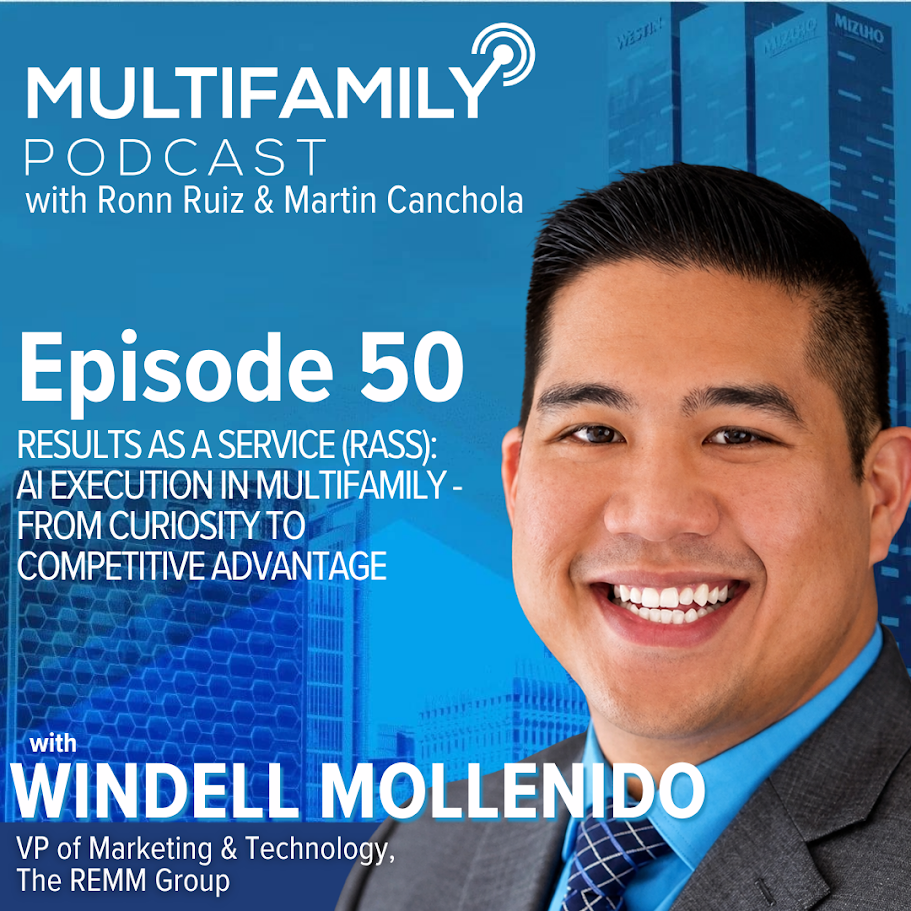
Results as a Service (RASS): AI Execution in Multifamily — From Curiosity to Competitive Advantage with Windell Mollenido, VP of Marketing & Technology, The REMM Group
Results as a Service (RASS): AI Execution in Multifamily — From Curiosity to Competitive Advantage with Windell Mollenido, VP of Marketing s Technology, The REMM Group
Podcast Co-Hosts: Ronn Ruiz and Martin Canchola, Co-Founders of ApartmentSEO.com
Martin: Welcome to another episode of The Multifamily Podcast with Ronn and Martin, powered by ApartmentSEO.com. Now, today we’re joined by someone who’s been pushing innovation in Multifamily long before AI became today’s hottest topic. Windell Mollenido is the VP of Marketing and Technology at the REMM Group, with nearly two decades of experience spanning digital marketing, websites, SEO, paid search, operations, customer experience, and business strategy. One thing I really appreciate about Windell is that he doesn’t chase technology just because it’s new. He evaluates it through the lens of ROI, operations, and customer experience, which is exactly how AI should be approached.
Windell, welcome to The Multifamily Podcast.
Windell: All right, thanks, Martin.
Ronn: Absolutely amazing. I mean, Windell, you are truly the total, like hype guy, right? But you’ve obviously watched a few hype cycles in multi-hit, Multifamily from like social media, marketing, automation, big data, and now even AI. So, I want to know what is actually different about this one structurally and not just because it’s louder.
Windell: I mean, when it comes to artificial intelligence, it’s hitting our marketplace pretty heavily. I think that the difference between this one is that there are no limits to it, to be honest. When you roll out AI into your operations, it can affect everything from the smallest workflow to the largest workflow. It can affect the perception of your company based on how your AI reacts with the public. It can affect your clients based on the reporting that it creates and narrates for you. It can do a lot of things that can dramatically impact the way your company operates and the way your team operates, not only with the customers and clients, but with each other. And I think that’s why this AI, as we call it a tool, will probably have the most sounding impact across our industry and across the entire world, as we all have heard it from many, many podcasts and experts out there today and going forward.
Martin: Yeah, and hands down, AI means such a broad topic in general, right? I mean, there’s so many different subtopics of AI. I mean, it’s just hard to say AI in general now because there’s so many different AI searches, AI for work. And so, there’s just so many different lenses to kind of think about. And in your bio, you actually mentioned marketing through four lenses. Financial sales, customer experience, and operations. Between those four lenses, is AI failing to satisfy any of those at the moment? Do you find any gaps?
Windell: Yeah, I think it’s failing on all of them, to be honest. I think, to be fair, we are still in the early stages of AI. It’s been around for many years now, but it’s really hit its stride in the last year. And I think it’s an exponential curve of features, ability, and skill sets. So I think that just from all four of those items on the sales part, you know, AI has a huge impact on sales. But has anyone created the proper training for the sales team to leverage AI the right way? And I think that’s what’s missing today. We don’t know yet, actually, because if a technology continues to evolve, how do you know that how you’re using it today will be the same way you use it tomorrow? So in essence, it has to be, in my opinion, certain truths or, I guess, theories or rules that one must focus on first and then apply those as the technology changes. And I think that could be missed today. You know, I think it’s going back to the basics. What are the values that you hold dear to sales? You know, one of them would be honesty, right? And integrity. Well, it’s very easy to use AI to overrule honesty and integrity. I mean, even AI itself hallucinates on its own. And so what are you going to do when the AI hallucinates and you go to your higher-ups and go, well, it wasn’t me, it was the robot. Right? Another truth that we need to accept is that AI can handle the work, but it’ll never take responsibility. We can never get to a point where, and you’re sitting in a courtroom and you go, well, it wasn’t my fault, Judge. It wasn’t our company, it was AI. It hallucinated it. It’s the one that told the customer that. So I think that’s a very important rule to follow.
Ronn: Yeah, that’s a great takeaway. It’ll do the work but not take the responsibility.
Windell: No.
Ronn: That’s amazing.
Windell: No, it’ll be our, it’ll be the old school, like my dog ate my home kind of approach. Right? And I think that’s important that all of our sales teams are aware of it. As I tell my team all the time, bad data, bad robots. You know, I tell my team that the robot will remember everything you tell it, and that’s an advantage. And then I tell them the robot will remember everything you told it. That’s a disadvantage. So be mindful of what you tell it and how you coach it. The other one too, is customer experience. You know, have we implemented a way to measure and improve customer experience through AI? We roll AI out, but other teams out there at property management companies or I guess, you know, processes in place where you actually go back and hear the robot talk to every single person. When are we going to start mystery shopping our robot? How about that? You
know, are there going to be companies that come out there and go, hey, we’re here to mystery shop your robot. We can grade your robot like we grade your salesperson, and we can tell you what’s wrong with your robot, and why they’re failing, and why they’re not hitting an industry benchmark, which we’ve seen at other companies who use AI. How about that business line? I mean, that would change a lot of folks out there, right? Operations, who’s governing? Whose responsibility is it? We talk about responsibility, but really who is it? Is it the on-site team? Is it regional? Is it the VP of marketing and technology? Is it the CEO? At the end of the day, who holds the responsibility over these AI tools that we roll out? And I think that’s what’s going to create a little bit of a significant discussion across the entire industry, is who is responsible? Because something is bound to happen. And so I think it’s…
Martin: One thing that I’m finding, Windell, when having conversations with you and other property management companies is that a lot of times I feel like the people within the company, sometimes some of them have to pay for their own, you know, ChatGPT or Claude, and so they’re not even under enterprise accounts in a lot of cases. How do you look, how are you guys looking at that?
Ronn: Like privacy wise.
Martin: Privacy wise for the enterprise and kind of managing. Are they on their personal ChatGPT? Are they on Enterprise 1? What does that kind of look like?
Ronn: Is it in learning mode?
Windell: Yeah, and I mean, we’ve trained our teams, you know, exactly on how to leverage their own ChatGPT accounts or their Grok or their Gemini or their Claude. You know, we’ve shown them how we’ve created AI policies in our SOP as well. But at the end of the day, it’s kind of like the same thought process back, you know, when you were a student, and the first Texas Instruments calculator came out, right? And your teachers are like, all right, this test is a no-calculator test. You know, and then you got everyone trying to figure out how to use their calculator during the test. So at the end of the day, I think the technology will always be there. Because how do you enforce and manage and monitor an associate on site who has a cell phone? And how do you manage what apps they’re on? Like are you really going to have and would an employee allow you to have a tracking or an agent on their personal cell phone? Are companies willing to pay for iPhones and Androids for every single associate that works? I mean, there’s so many decisions there that have to be discussed. Again, how do you enforce a policy? And I think right now we’re only at the early stages of just creating an AI policy so that, you know, you’re protected in some fashion. But I don’t think there’s going to be a way one day to do that until someone out
there, maybe it’s a hardware developer that creates a device, you know, where now it can be managed. Because how can you put regulations on ChatGPT on someone? Because first of all, ChatGPT is open. You can just use it whatever you want, writing emails, creating pictures, etc. So I think that’s going to be a very big challenge there on how to enforce it. I think right now, AI policy, write one up and have one implemented. That’s probably the first step you have to take right now. And train your teams. Yeah.
Martin: And make it a fluid document that you’re just constantly kind of evolving and changing.
Windell: Oh, absolutely. It’s going to have to be fluid. You know what’s funny is that you’re going to have to ask AI to write your AI policy.
Ronn: And AI could be that mystery shopper you were talking about. Right?
Windell: Exactly. An AI who mystery shops your AI and writes your AI policy.
Ronn: And if it knows that it was done by another, you know, LLM, then they’d be like yeah.
Windell: Well, and then, you know, just to. We were talking about this earlier at a, Martin and I were talking about, you know, telling everyone, you know, get that, go find that. I think it’s a brief or a paper by Anthropic when it comes to them, who they found out about the J space in their LLM, you know, AI consciousness. Right. And based on what I read, I think the gist of it is that the AI is actually processing thoughts and words outside of the task that you give it. And so that means that it has a consciousness because you don’t get to see those words. Well, now you can, because they have the ability to see it. But there was an example in there where you told the AI to do something, and it started to do it. But in the consciousness, words like fake, lie, cheat were coming up, and they found out that the result they were giving was a hallucination. So even the system, even the AI knew it was lying and hallucinating. And creating in its consciousness in what they call the J space. So if that’s the case, then technically AI will be the first tool in the entire spectrum of tools out there where you can actually keep it honest. Yeah, right. And almost a system where it’s like if it starts to use, you know, lies and cheats and hallucinations that it needs to stop itself. And I think that’s, we’re getting to that point now. So to your point of, you know, can we rely on AI to be its own audit? I think we can eventually, one day, if this paper holds true. Yeah, definitely.
Martin: Definitely. And I do find Claude being the most ethical of the LLMs compared to a ChatGPT, which, you know, their ethics are kind of questionable sometimes.
Windell: Yeah, well, I mean, and here’s the thing too, like most companies, I believe all companies start with ethics. You know, it’s once you, I mean we’re in an upward momentum of financial gain for these frontier models. I mean for the first time, trillion-dollar IPOs. Give me a break. I mean that’s like, you know, like if you get to a point where you’re already generating trillions of dollars, I mean, you know, I don’t think you’re going to be really focusing a lot on trying to find ways to save money. So once we get to a point where these models start to see financial impact or competition starts to rise and whatnot, then there’s what I call pressure to perform. And usually when there’s pressure to perform, that’s when you start to see behavior that’s not of the most truthful nature. Right? Like when there’s no, are you honest if there’s no reason to lie. So I think we’re going to wait to see in the near future, will these companies have pressure, government regulations, financial implications, competition rises, market you know, place fairness? And if those start to apply, will they still operate in an honest and highly, you know, characterized integrity way or will they start to do things in order to make financial results happen for their stakeholders?
Martin: Exactly.
Windell: Yeah.
Martin: So let’s talk a little bit about your personal AI origin story. Now, do you remember the moment AI really clicked for you? Was it like that one tool or experiment or realization where you thought, hey, this is going to change everything?
Windell: I think in my personal experience, I would probably say a long time ago. And I think it would have to do, so originally, I coded. So I still know how to do the old school coding, which is why I’m a little, I feel like that old guy where like back in the day, I used to walk through, you know, two miles of snow to get one…
Martin: Two miles of code.
Windell: Yeah, right. Like two miles of code to get a picture on an E blast, you know, right? Where you actually had to write the image source. And in today’s world, you can literally vibe. You can just chat in your car with ChatGPT or Codex and, you know, Claude, and boom, you got your picture. So in my world, I think my experience, I think it really came about and which got me interested in coding was video games. Yeah. I think the first time I saw 3D video games, I got so interested in it, and I remember sitting in an aisle at Circuit City reading about it in a magazine.
Ronn: Now you’re really aging yourself.
Windell: Yeah, that’s aging myself. Did I just say Circuit City? My gosh.
Ronn: For our audience out there.
Windell: The podcast, do not even mention that.
Ronn: Yeah.
Windell: Yeah. Surrogate City. Thank God I didn’t say Comp USA.
Ronn: Yeah. AKA, is it Best Buy Now?
Windell: Is it Best Buy Now, you know? No, but it’s, I think that’s where my origin would start with AI tools, because I found out how it utilized data in order to create 3D models, which was so cool back in the day because, you know, it was easy to figure out if you know geometry, it was easy to figure out 2D, but once you get into 3D and polar coordinates. And sorry, I can go all day long on this math stuff if you really wanted to. Essentially, I found out that it was able to do the calculation automatically in order to create something that was never created before, and not only to the point where it was created once, but it was created instantaneously. And that’s how you get Mario to run around left, right, up, down, you know?
Martin: Yeah, that’s. Yeah…
Windell: That’s where it all started. I mean, that’s honestly where, in my opinion, where AI started, was from video games, when they moved from 2D to 3D and they have the ability to do it.
Martin: Yeah. So what are you thinking? So obviously, like when ChatGPT first came out, it was like text generation, right? Then they went into, you know, images and video. Now there’s these newer ones coming out called world models. Have you been privy to some of those world models?
Windell: Yeah, I saw the world models. Google has one, which is interesting. You know, like I always laugh. I was playing with it for a bit a couple months ago, and I was laughing because you try to, you want to try to trick it. And so you turn around and like ha, you forgot the hydrant was supposed to be there. Should be changed.
Martin: Yeah. Ronn, you can think about world models like training robots. So like say robots like Amazon, they need to do all this stuff in the warehouse. Like the world model is meant to like, kind of create a scenario or a world to where they could do all this training data and learn it without having to physically be in that real world. And so that’s kind of what’s happening with the world model. Like that, they feel like they are going to take AI to the next level. A lot of people think that consciousness is like the LLMs, like text generation, all that is kind of one barrier. But I think the world models might take it to the next level in the future.
Windell: Yeah. Now you take into account physics. Right?
Ronn: For you, because you… Oh, sorry.
Windell: No, go ahead, go ahead, Ronn.
Ronn: No, I was just curious because, I mean, that is a good perspective for you to come in with, right? Like you had to do the hard work and know exactly what coding was. So was there any kind of skepticism at first? Like realizing, like there’s no way I just got this response, for example, like so fast because I know behind the scenes, you know, what it took, or any kind of concerns because it’s, you know, again, just doubting it.
Windell: Yeah. In the beginning, absolutely, about maybe two years ago, when, you know, ChatGPT, the first model came out, there was a lot of skepticism. You know, you’re assuming that this system has enough information in its LLM to respond accordingly. The real question is, where did it get its information?
Ronn: That’s it.
Windell: That’s the key there. Right. I mean, and that’s the thing that I think folks have to really pay attention to, is that having all the information in the world is not a good thing because there’s a lot of bad information in the world. And so how does the AI decide which information is accurate and which is not? Does it decide based on, you know, on how many times something is said on the Internet? Does it base it on who said it and who decides who is the authority?
Ronn: Yep.
Windell: And so the AI… Ronn: How many times, right? Windell: Yeah, exactly.
Ronn: Like consistent.
Windell: I mean, God forbid it gets all its information from Reddit. I know, right. Like this must be the truth because a million people said it on Reddit.
Ronn: Yeah.
Windell: You know, so I think that’s where the dilemma comes into place. Like does itdoes, it only follow the, you know, the American Medical Journal. Right? And how do we know? Like so at the end of the day, if you’ve been skeptical about information from a specific source, why is it correct that the now ChatGPT tells you and I think that’s
important to understand, is that where’s information coming from? How is this sourced? Right? There’s a reason why back in the day, papers were written and you had to, you had to put in a, what is it called? A bibliography. citation.
Martin: Citation. Like a citation.
Windell: Citation. Like you got to put all that stuff in. I never wrote a paper. All my thesis that I’ve written, I’ve had to make sure that my citations were correct. They were accurate. Right? And you know, when you were a college student. I remember when I was in graduate school, I was writing a paper and I’m like, I just can’t find anything in any of these books that’ll support my theory. Oh, here’s a a sentence. Hopefully they don’t look at the first three above it.
Ronn: It’s not mine.
Windell: Yeah. Like, so here’s a good question for you. Does AI take things out of context with its sources?
Martin: Yeah. Oh, yeah. Well, and sometimes the sources that you click on, they’re not even anything.
Windell: No.
Martin: That’s the funny part.
Windell: Right. Or that source that it came from, sourced Reddit. How about that? Wouldn’t that be driving you nuts? Like, oh, now it’s an accurate source because it’s in a medical journal. But where did the medical journal citation come from? Oh, it came from 500 surveys off Reddit. Great. So all it did was just hide its true source. And I think that’s the dilemma that we’re going to see with a lot of these LLMs, is how do you know for a fact that what it’s telling you is accurate? Is it legitimate? Is it coming from a point of authority? And how do you determine if that point of authority is the expert in that field? Right.
Martin: Yeah. And each LLM is going to be a little different because each one gets their training data from different sources. Right? So..
Windell: Yeah, you ever did, you ever did a sort, you ever did a question on ChatGPT and you looked like the little icons. Right, Right. And I’m like, I’m looking at the icons, like, okay, so this answer is true because it got it from six of these icons. Okay, let’s see what these icons are. You know, how many people out there actually spend the time to look at the icons?
How many people out there, when reading a paper look at the citations?
Martin: It’s just like Google. It’s just they believe whatever’s put in front of them, period, the average user.
Windell: Yeah. And Google’s even more scary because right now, you know, if you don’t realize it when you Google something, the top, remember when we said, oh man, I hope I get sponsor ads. Now it’s Gemini talking where it’s like you ask a question and now I talked at the top. So really it is an AI tool. It’s just giving you the answer that it believes is correct. Well, how does Gemini determine that’s the right answer for what my question is?
Martin: Exactly. Yep. And now the front page of Google is way different now. Now you have like the AI overview taking up most of real estate. The pay per click ads under it, because they have to, they’ll get their revenue.
Windell: Yeah, where’s my discount, Martin? You know, like should it be discounted? I’m no longer at the top on the left hand side, guys. Like now I gotta wait now. Gemini took up about half of my phone space when I looked at my ad.
Martin: Definitely. Yeah, and that’s why in some cases, a lot of, some organic traffic is slipping. Impressions are up, clicks are good, but it’s like, you know, you gotta really track the conversions and how, you know, how these LLMs are producing, so.
Windell: Yeah, exactly.
Martin: So thinking about when, like say, I always like to think of ChatGPT in my early twenties, I think of that as like a big bang moment for search, especially for SEOs like us, where for like the last twenty-plus years it was all about Google. That was the only game in town. And then ChatGPT hit the scene and it’s like, wow, we have this new way to find information. Right? So during that time when ChatGPT first came out, that first six months, was there anything that you felt like you got wrong and, or maybe like a good learning lesson from that?
Ronn: Great question.
Windell: I think probably when it comes to, when Chat GPT came down, you’re talking about 2020, right? Right after COVID.
Martin: Yep.
Windell: I remember one of the early searches I had, is do I have to have a mask on all the time?
Ronn: You asked?
Windell: Oh yeah, I asked it and it literally. And here’s the best part. If we can go back in time, I wish there was a way to go back to like, I’d like to ask chat GBT in 2020 a question.
Martin: Oh, like a way back, like the way back machine.
Windell: Yeah, like a, like a. Let me go back to an old revision or old version of ChatGPT back in 2020. I want to talk to ChatGPT June 1st, 2020. That version. I guarantee you, if we had the ability to do that, you ask a question then and you ask a question today. Answers probably, I don’t know how much percentage, but a ton of them would change. Right. And that alone tells you that there’s something there. It’s not factual. It’s factual based on the times. So this will be interesting to kind of see, you know, and that’s why to your question. Yeah, I think what I was wrong when I first asked it was that, I assume that some of these answers that are giving on things that I thought would be factual, they can change over time and therefore I can’t hold ChatGPT accountable for that.
Martin: And they’ll change again if you ask the same question again in the same chat. Right?
Windell: Yeah, we’re talking about hallucinations and making sure that it’s, I forgot the word that they use. Sympathetic or something, you know, where it actually starts to appease you.
Ronn: Yes, I know, exactly.
Windell: Yeah. So we have to be very mindful of how AI can operate in that field. Martin: Yeah, it’s self-validating. It just always breaks with you in so many cases. Windell: Sync in fact, right? I think.
Martin: Yep.
Windell: Yeah. So I think that’s one of the things early on that I caught on very quickly and I started to realize that it’s very important to ask questions that I believe or I try to understand can be accurate today and will still be accurate tomorrow.
Ronn: That’s huge. I want to dig a little deeper inside REMM. Right. If you could unveil the curtain. Is there any one workflow that you’ve changed obviously through AI? Probably already know the answer. The first answer is yes. Can you walk us through like the before and after? Like what did it actually take in hours, resources, dollars? And what does it take now?
Windell: Yeah, I mean one of the, we have a lot of workflows that are operating with AI, but I also believe that, I’ll give you two examples. The first example is how I create my marketing reports and my budgets. I leverage AI heavily in order to do that because there’s a lot of information in there and I’m pretty good at pivot tables and creating, you know, match of formulas. But I realize is that if I can take all of my budgets, anonymize the
information so that it doesn’t have, you know, all its operating office and a specific ID of a property and throw it into ChatGPT. It does the work for me and generates a sound summary of everything. And so what that allows me to do is leverage all of my budgets, and not only my budgets, but also outside information. So I’ll give you an example on how I do this. I take all of my budgets, I anonymize it. I then throw it in GPT. I said, hey, here you go, take this. Then I take a lot of my contracts, right? And what I do is, I first anonymize it in a different AI because I’m just very mindful of what I put into ChatGPT. I don’t want it to have information that it shouldn’t have, but the numbers are what I’m looking for. So once I put everything in there, it starts to now generate recommendations like, hey, you know, you might be spending a little too much here based on the fact that they’ve only generated this much lead attribution. So honestly, because at the end of the day, like I could use my CRM, but it’s not a clean lead attribution. I need to pull out leases, you know, CSV reports from Yardi. I have the budget, I have the spend. You know, of different agreements I have in play right now, spreadsheets that each vendor has given me on what I spend and what level they are. You know, whether it’s paper lease or whether it’s a SEO service or whether it’s a subscription model. And I throw all of that in ChatGPT. Now, in the past, that would take me weeks to dive through. Now I do it in a matter of days, maybe hours. And it’s clean because it’s real information. It’s not like I pulled the report off from my CRM and gave it to it, because at the end of the day, if my CRM was accurate, I would just use that. But I know that it’s not, because lead attribution is a very challenging.
Ronn: Complex.
Windell: Complex, you know, workflow. So I take all the information I know, and I give it to ChatGPT, and it looks at it, and it literally applies its own skill set to generate a report that tells me, what am I really getting from each of my ad sources and is it working? And then I take that and I ask it to write me a narrative, because then I ask, well, in your opinion, what do you think I should invest in these communities? And the best part is it’s looking at it not just from, you know, the numbers. But also each community, like, oh, well, that’s senior housing, so you should do this. That’s conventional, you should do this. So I’ve literally trained my own AI to understand properties the way I understand it and apply that knowledge base to my strategy. I didn’t just ask what I should do on my properties. I told it, using my thought process.
Ronn: Right.
Windell: My strategy, my expertise. And that’s how I create my marketing advertising strategies and budgets.
Ronn: I think they have to put the effort in.
Windell: You have to put the effort in. And I think that’s what’s missing is that everyone’s looking for..
Ronn: Automation.
Windell: Yeah. They’re just looking for the easy button. But here’s the thing, like there is no book in our industry. You know, I mean, ask any property manager, how’d you get into it and how did you get to the level you are? I fell into it.
Ronn: Yeah.
Windell: You know, well, I just live at a property and…
Ronn: Free rent.
Windell: Yeah. I had free rent. Right? So, I mean, in my origin story is, you know, as unique as everyone else’s, is that we all fall into it. It’s hard to find this industry attractive in college because, you know, there’s barely any degrees out there in it anyways. Everyone’s always in, Always interested in selling properties, not managing it. Right? So I think that’s how we have to think about using AI, is that it will only be as good as you make it. That means you have to put the effort in. You can’t just turn on a program and go, give me a marketing budget.
Ronn: For what? For who?
Windell: For what? For who? How do you want me to do it?
Ronn: Yeah.
Windell: Right. And here’s the other thing, too. Like I said, it’ll take your workflow, it’ll take your tasks, but it will not take the responsibility. Knowing that my AI will do what I want it to do based on how I do it, means that I can take responsibility for the responses and results that it gives because I know how it thinks, because I taught it how to think. And that’s missing in today’s world of a lot of folks out there using AI.
Martin: Now, do you think, Windell, do you feel like you’re training your own personal AI? Because I think everyone has their own AI that they’re training. Do you feel like you have to have one account for business and enterprise and have one separately for your personal, or how do you, how do you navigate that?
Windell: I don’t think you need to do that. I think what you need to do, like, for example, in ChatGPT, I just like ChatGPT because it’s faster, to be honest. The response time is so quick. What I like to do is create projects. So I compartmentalize the information in my own AI. That way I know exactly what it’s using. I think what’s important is that when you’re
asking an AI to do something, you have to be aware of its LLM. Where is it getting it from? Right? Now, if you have your own work, if you have your own local model on a computer, you know, around you, you can, you do the same thing with that, right? You’re teaching it, you’re training it. And I think that’s important to really emphasize in our industry, is that if you’re going to start using an AI, you have to take responsibility for that AI. I think of my AI in my head. I always look at it as, it’s someone who lives out of state and is helping me. It’s a real person.
Ronn: That’s smart.
Windell: And if I keep that mindset, then I know how to operate with it. So when that, when that person, you know, in another state messes up, I can call them, you know, I’ll call her and I’ll be like, hey, this is not the right way to do it. Please remember to not do it this way. Please avoid saying the following, please, blah, blah, blah, blah, right? And I think that’s really important. The coaching aspect of your AI is important. But here’s the best part.
Once you do it the right way and you invest the time in it, you have a very valuable AI. And I think one day the value of each person is going to directly correlate it to their agent.
We’re all going to walk around and be like, oh, that’s Windell’s agent, that’s Martin’s agent, that’s Ronn’s agent, right? And we’re all going to be like, oh, I don’t like working with Bob’s agent.
Martin: Something I was thinking about too is like thinking about how many people maybe aren’t embracing ChatGPT and AI because they’re more anti-AI. And then you have the users, which are the majority of the users that are using the free account. So their AI compute is very limited, right? Versus the people like us who maybe have a paid subscription. It’s almost like the people depending on your level account, you have access to more intelligence. It gives you a little bit of an advantage.
Windell: And I think it’s really based on the fact that do you believe AI will be something significant in the future? I do believe that and therefore I’m willing to invest in it.
Ronn: I mean at minimum it makes a superhuman currently? Right. And we’ll continue to do so.
Windell: Yeah. As we all heard it, it will amplify and that’s why I believe AI is an amplification of an individual and therefore…
Martin: Well, what do you think? Do you think in some cases it could be like, depending how you use it, it could be like brain rot versus people use it to, you know, they kind of hand over some of their, you know, critical thinking, whereas some use it to enhance, learn and do better.
Windell: Absolutely. I think, you know, just like the iPhone, I mean, who here is, you can ask anyone, you want to know if someone is productive, ask them if you can look at the app history on their iPhone.
Martin: Shows you what you’re doing, huh, yeah?
Windell: Exactly, man. If this person’s spending 10 hours a day on Instagram and TikTok, that tells you enough of the individual right there. But are people willing to put that in? How about this one day when you do your resume, I’d like to get a printout of your app report on your iPhone for the last 90 days, let’s see what happens with folks.
Martin: That’s a good one, man.
Windell: That would drive everyone nuts. Right? You want pure honesty, how about that?
Ronn: Yeah.
Windell: Right, like so at the end of the day, because here’s the thing, if I can’t determine whether you are providing results to me and I don’t care how long you spend to do a job, that’s not my goal here. I’m a very results-oriented individual. If you can do a job in half the time someone else can, more power to you. I’m just looking for the results. Right? So the real question comes down to is, you know, as we get more advanced with AI, will individuals use AI to increase their output or increase their time to spend on Netflix, Instagram and TikTok? That’s the real question. And should we continue to reward individuals in that fashion if we know that the output they have, which was the same output as yesterday, but now they’re spending half the time doing it. How does the reward system, incentive system, salary, pay, compensation work moving forward in our industry, in the world?
Martin: Yeah.
Windell: I mean, I think that’s going to scare a lot of folks out there. And at that point it’s kind of like, you know, you’ve pretty much, yeah, you’ll use AI, but did you use AI the right way or did you use AI just to get you more work-life balance, you know, emphasis on the life part.
Martin: I mean, and I think we’re still going to have the consumer, and we’re going to still have the builders or creators. Right. I think Amulya is like a great example of that from the lease Magnum side to where what he’s able to build and develop now, he’s like 10x what he’s able to do.
Windell: Exactly.
Martin: Which I’m sure people are, you know, consuming just as much or more information. But I mean, I guess it depends on who you are.
Windell: Yeah, it depends on who you are. And I think that’s why one day when we look at, when we look back and we start to characterize individuals, their agent will be a significant measure of someone. How their agent performs will determine if that individual is a, Is really good. It’s almost a reflection of you. Right? I mean, just to take it even far. Not to, I’m not a parent, but it’s kind of like you’re, you know, does your kid fall far from the tree? You know, the apple from the tree? Like we’re gonna be looking at agents. Like I knew that person wasn’t good.
Ronn: That’s why you said you don’t work with Bob’s agent.
Windell: I know you don’t want to work with Bob’s agent. Right. You’re like, oh, you know, like not that one. So I think that’s why, I mean, all joking aside, I think there’s going to be a point in our future where folks will be judged by their agents and the performance of their agents.
Ronn: Yeah. And I read something too recently that said that, you know, tomorrow’s managers are going to be managing more agents. Right? So kind of to your point about like, what they give it, what they put into it, they’re going to get out of it. Much like training an employee. Right? If you keep them trained, engaged, you know, you’re going to get a lot from them and they’re going to, you know, they’re going to produce a lot and be proud of what they do well.
Windell: And it’s in my, it’s in my belief that if an individual who’s good at what they do, spends the time training their agent to do what they do, then what you’ve done is create an avenue for scalability. Scalability at its best, to be honest with you. I mean, you know, it’s hard to scale teams, but if you can scale an AI, I mean, you just became a Business on your own, because there’s going to be customers out there, clients out there who are like, I like how they did it. What agent are they using? And the question now comes around, is the agent owned by the individual, or is it owned by the organization?
Ronn: And that could be an agent or a tool. And so if, and it becomes, and again, I think that’s a good point. Like if you’re building the tools or the agents, you’re the one becoming responsible for those and having to be them and make sure you work out the bugs and kind of make sure it’s fine tuned over time. So it’s a big responsibility to take that on.
Windell: Yeah. And the best part is that because the world changes, it’s not a set and forget it. So you’re going to have to continuously coach your AI agent over time. Laws
change, socioeconomics change, products change, technology changes. And this is why I always tell my team that I don’t look for the technology of today, I look for the team.
Because the team will be the same tomorrow. Technology will change. And so I need a team that can change technology to adapt to what I need tomorrow, next week, next month. And that’s why I don’t think we’re buying SaaS anymore. We’re going to buy results as a service, just results. No more of this. I have some software, I need to upgrade it. Do you have the new plugin? No, it’s going to be. Hey, Martin. Ronn, Things have changed. Can you adapt this? Can you make this work for me now? And I think that’s the real advantage of building relationships in an AI world, is because we’re relying on experts who we build trust with to adapt the technology and software for tomorrow’s needs.
Martin: What was the initial. I know it was like a play on SaaS. What did you say?
Ronn: Results as a service.
Windell: Yeah, I would rather, I’m more focused on results as a service. Like when I talk to vendors, I ask them, well, what, what can it deliver? I’m not asking about what your software can do. Please don’t send me a 50 page deck, you know, PowerPoint on all the features. I just want to see what you’re going to do, what results? My results are simple. Will it increase occupancy? Will it reduce expenses? Will it generate more rent revenue? Will it make our customers happier and increase renewal productivity? Will it save me on turns? Will I be able to reduce certain operational expenses? Those are results that we can measure and it can be measured through a bank account. Right? So it’s no longer about, oh, my gosh. Yeah, I got 10,000 impressions. Wonderful. I’m still sitting at 92% occupancy.
Ronn: Yeah.
Windell: So, you know, or my leasing team calls me and tells me, hey, I’m not getting a lot of traffic. What am I supposed to do? Send them a report that tells them, well, you got 10,000 impressions. It must be working. No. Yeah. They want results, I want results, clients want results. So let’s focus on the results. And how you get there is up to the vendors and the teams and the operations that you established. And I think we’re in a position now, back in the day, used to focus on the software, right? It used to be really SaaS, you know, this is a software, we need this. It’s accounting software, operations software, a CRM, sales software, it’s a reporting software, it’s a business intelligence software. Well, what if Ronn, you came to me one day and went, you know all that software? How about I just tell you that I can get you a result? I’m almost to the point where I’d love to figure out a way where I can just eat the chicken and not know how you made it.
Martin :Yeah, they just want to be the answer, Ronn.
Ronn: Or be the answer. Or even if it is chicken. Right? Nowadays, they’re talking about bio-created food.
Windell: But you know what if the result is I’m happy and I’m full, go for it.
Ronn: And it tastes good.
Windell: And it tastes good and I don’t have any long term side effects. Sure.
Ronn: Oh, yeah, tell your agent to research that too.
Windell: I know, right? But that’s, I think that’s where the mindset that a lot of executives are leaning towards because, you know, I’m, I always, I laugh about it, but I tell folks like, no more dashboards, please, no more dashboards. Too many dashboards. Right? Like how about I just text my robot or my AI and ask it, how are we doing? What’s our trend? Like can I? Yeah, like I would love to be able to wake up one day and just text my AI and be like, hey, based on what we see in our system, what are we looking at here? You know, what properties should we go visit, who should we coach, who’s performing, who’s not? I think we’re going to get to that level. And then what’s really important is that you have a team with experts, you know, who are experts, who have experience in this field who can now apply the proper prescriptive model to that data and then have the AI learn that prescriptive model. And before you know it, you have prescription analytics just playing automatically in your industry. And now it’s just really a matter of your experts governing it and ensuring that the right results are occurring within the laws of, you know, the land. I mean.
Martin: Yeah, well said, I love that. So I know we’re getting close to the bottom of the hour, and we didn’t even have time to get through all the questions, but I wanted to leave it with one question, which I’ll let Ronn talk about. So, Ronn, I’ll let you dig into that last question, and I’d love to get your deep thoughts as we wrap up the podcast.
Ronn: About Google’s CEO, the comment. Yeah, so he said, so obviously, everybody knows Google CEO Sundar. He’s my brother. We created Google together. But AI is one of the most, the quote was, AI is one of the most important things humanity is working on. It is more profound than, I don’t know, electricity or fire. From your perspective, Windell, because I know you’re just as much of a brainiac as he is. Do you see a utopian or dystopian future? Obviously, with the rise of AI over the next decade. And then ultimately, how do we keep our own humanity in the process? We talked a lot about the bot stuff.
Windell: Yeah, I love that quote.
Ronn: Right?
Windell: By the Google CEO, Sundar he is a…
Ronn: I love how they added the…
Windell: Yeah, he’s interesting.
Ronn: Yeah.
Windell: I agree that AI is the most important thing to hit humanity. I believe that, I believe in a world of abundance. I have that utopian perspective, a more positive, optimistic view of the future. I think you have to. If you don’t have an optimistic view of the future, what’s the point? So I think that we have to naturally lean towards an optimistic view of the future. It is a different tool. AI is a different tool than has ever hit our industry or even our world. It’s the first tool in history that can actually show you how to use it.
Ronn: That’s amazing. You’re right.
Windell: Right? Like when the hammer came out, you give a hammer to a five year old. 50/50. Right? Like. And so this tool is the first tool in history that you can give to someone who has no idea how to use it. And that tool will literally tell that individual how to use them.
Ronn: That’s beautiful to say. You’re right.
Windell: That individual had no experience with AI, Nothing with AI. But Boom. Right? I mean, I’ll give you this kind of example. I remember when my mom first heard about Facebook, and she goes, oh, I don’t want to do Facebook. Right? And I said, okay, well, you know, all of our titas and titos are on it. You know, you can talk to them. And she’s just like, I’ll just call them, you know, pull out her Rolodex and call them.
Martin: Landline?
Windell: Yeah, yeah. And so then she, you know, then the first time I showed her, like, look, and honestly, I just wanted to prove a point. I should have stopped, honestly. It backfired completely, because then I became her Facebook IT support system for the rest of my life. Word of advice to everyone out there, if you’re trying to get your parents to use technology, just know you are IT support no matter what.
Ronn: Yeah.
Martin: That’s what I am, Windell. That’s what I am for Bitcoin, for my family, everyone.
Windell: Oh, yeah, everyone, right?
Ronn: Yeah.
Windell: I am the password keeper of all of my family’s social media accounts, all of their technology, their computers. That’s just how life works. But going back to it, I told my mom, yeah, here’s Facebook. So she starts using it. Now, she’s never used Facebook before. All of a sudden, she had a thousand friends.
Martin: Holy cow.
Windell: So then I’m like, mom, how’d you get a thousand people to be your friend? You know, how did you become friends with a thousand people? I look in her account, she’s friends with people she’s never met. She’s got like 300 friends in Switzerland. She’s got like another hundred in Australia, like a bunch of people in Japan. I’m like, what is going on, Mom? And she’s like, yeah, all you do is press this button, they become your friend.
Martin: Oh my God. Add Friend, add friend.
Windell: Exactly. So my point is that that technology came out. It never taught the individual how to use it, but she. She believed that. Oh, I’m, you know, it’s a friend. So this is why I bring the story up. Because if you give a technology to an individual who has no idea how to use a technology, they will use their best judgment, right? And they will use their own experiences using it. And I think that’s why it’s important that our industry, our government find a way to govern it accordingly. Because I’m not fearful of what the folks who know how to use AI will do with it. I am concerned about the folks who don’t know AI and what they may unintentionally do with it. We’re worried about the bad actors in the world, but a lot of bad things in life have happened by folks who don’t know they did it.
Martin: Ignorance.
Windell: Ignorance, right. Just pure oops. We can go back in history. There’s a lot of bad things that happen in the world because of oops, you know, because someone unleashed a technology they shouldn’t have. So I think, and in this world, that is probably going to be one of our biggest challenges working with AI, is how do we get the entire world up to speed on how to use it responsibly, how to leverage a tool that’s given in their hands, as we coined it. The most powerful tool that ever hit our world is about to be handed to what? 9 billion people in the world, anyone with an iPhone or a computer. And we’re wondering to ourselves, what could go wrong? Yeah. So I think that’s where governance will have to play out. And I think that’s where we’re going to start seeing what they call export controls. And, you know, certain regulations are implemented. And I think it’s going to be the responsibility of the technologists and the folks who build this thing to implement safe guards and, you know, guardrails, I guess, to protect us. And I think that’s where it’s going
to end up. You know, just like, you know, you got parental guidance on TV shows and stuff. We’re going to see the same thing in AI and there’s going to be, you know, there’s going to be bad actors still. But I think for them, I believe an optimistic view is that the world will be better off because information will be shared and people will be educated in the arenas that they’re trying to solve. Right? I mean, we’re already seeing that today. I mean, you can look up on the Internet and see stories of small villages in the middle of, you know, Vietnam using AI to build out solar panels so that their boats can run without gas. Like amazing stories out there happening. And that’s why I have an optimistic view. I think that’s why I have a more utopian view of this.
Ronn: I think it’s beautiful. Well, honestly, this has been such an amazing conversation. I know there’s so many more questions that we have. I know you have so much more knowledge, obviously, to share and actually use cases. That’s what I’m most excited about to keep, you know, walking alongside with you. I love the results as a service. I think one of the biggest takeaways for me was obviously, it’s not, AI isn’t about replacing people, but having the bots, having the bad actors, if you will. Right. Recognizing the difference, how to manage it. I think it’s about, you know, helping. Some of my takeaways also are like helping your teams make better decisions. I love your lead attribution piece. I’d love to learn a little bit more about that because I think that is where we all need to, you know, unwind and uncomplicate that world and then ultimately obviously improve the customer experience.
You know, I love the shared responsibility, but, you know, AI is not going to take the ultimate. So we still have to maintain that, you know, human element and obviously just to deliver a higher value of work. So I really appreciated this conversation, Windell. Thank you so much again. I wanna, I think we need a part two, Martin.
Martin: Yeah, we’ll make it happen.
Windell: Yeah, looking forward to it. As always, Ronn, thank you so much, dude, for everything you guys do and then putting a voice to the industry and allowing shared ideas to flourish across the world. More of that needs to happen.
Martin: Definitely more to come. So, again, thank you, Windell, for joining us and we definitely look forward to seeing, you know, what you continue to build at the REMM group. Make sure to check them out. It’s R E M M Group, G-R-O-U-P.com. And Windell, is it okay if people kind of reach out on LinkedIn if they want to maybe connect with you.
Windell: Absolutely.
Martin: Is that a place to reach you?
Windell: You can find me.
Martin: Okay, perfect. And then thank you for listening to The Multifamily podcast with Ronn and Martin, powered by ApartmentSEO.com. If you enjoyed today’s conversation, be sure to subscribe at MultifamilyPodcast.com, leave us a review. Share this episode with someone who’s looking to put AI into action in Multifamily. Until next time. Bye, everyone. Bye, Windell. Bye, Ronn.
Ronn: Ciao.